This article contains affiliate links. We may earn a small commission if you purchase through these links, at no extra cost to you.
Three-day power outage. Knoxville, Tennessee. Nineteen degrees outside.
My neighbor Rick was standing in his driveway grilling frozen chicken nuggets on a Weber charcoal grill. In a bathrobe. In nineteen-degree weather. Because he had no other food he could cook and no plan for what to do when the electricity stopped.
His wife was inside crying. Their two kids — maybe four and seven — thought it was an adventure for about four hours. Then the house dropped below 50 degrees and it stopped being an adventure real quick.
I brought them a propane heater and some canned soup. But that image — a grown man grilling kids’ food in a bathrobe in the dark while his family froze — that one stuck with me. Hard.
Rick wasn’t stupid. He was a project manager for a construction company. Owned a nice house. Had a 401k. He just never thought about what happens when the stuff that always works stops working. The heat. The lights. The stove. The faucet. All of it just… works. Until it doesn’t. And then you’re standing outside in a bathrobe grilling nuggets.
Most people are Rick. And I say that without any judgment because I used to be Rick too.
Who This Is For (And Who It’s Not)
This isn’t a guide for people building underground bunkers or stockpiling five years of freeze-dried food. Some people are into that. Fine. No judgment from me. Go wild.
This is for normal people who want to handle the stuff that actually happens. Power outages. Hurricanes. Ice storms. The water main break that puts your town on a boil advisory for a week. A wildfire evacuation where you’ve got 30 minutes to grab what matters and go.
Been through all of those. Some more than once. And every single time, the difference between “this is annoying” and “this is actually dangerous” came down to about $300 in supplies and maybe four hours of planning.
Yep. Not thousands. Not a lifestyle overhaul. Not a shipping container full of MREs in the backyard. Just some thoughtful prep that most people keep meaning to do and never actually do.
Watch: The Gray Man Concept for Emergency Preparedness
First Thing — Figure Out What’s Actually Going to Happen to You
Before you buy anything, sit down for ten minutes and think about what disasters are realistic where you live. Sounds obvious, right? You’d be amazed how many people in Phoenix are prepping for blizzards. Or people in Kansas buying hurricane shutters. (Okay I made that second one up. But barely.)
Grew up in Ohio. Tornadoes and ice storms were the big threats. Moved to Florida for a few years — hurricanes, obviously. Now I’m back in the mid-South. We get a little of everything here. Derechos, flooding, ice events, the occasional tornado. Each place had different priorities and I had to adjust.
Quick framework for figuring this out. Grab a piece of paper:
- What natural disasters hit your area? Look at the last ten years of local news. FEMA’s website has risk maps too.
- How long have past events knocked out power? My neighborhood lost electricity for NINE DAYS after Hurricane Irma in 2017. Nine days changes your math on supplies pretty dramatically.
- Municipal water or well? City water with the power out? You probably still have pressure for a while. Well pump? You’ve got whatever’s in the pressure tank — maybe 30 gallons — and then nothing. Zero.
- Who lives in your house? Infants, elderly parents, pets, someone on daily medication — each one changes what you need.
- Can you shelter in place or might you need to leave? This one matters more than people think. Flood zone? Wildfire area? If there’s a real chance you have to evacuate, your prep looks completely different than if you’re riding it out.
Well-Water Homes Lose Water When the Power Goes Out
If your home uses a well with an electric pump, you lose water access the moment the grid goes down — not just hot water, but all water. The pressure tank may hold 20–30 gallons, which is gone within hours. This makes water storage even more critical for well-water households than for those on municipal water systems.
Buddy Craig in Northern California keeps his truck loaded with a 72-hour bug out bag every fire season. Smart. He’s been evacuated three times in five years. Meanwhile, I mostly prep for sheltering in place because my biggest threats are ice and power outages. Context matters. Your neighbor’s plan might not be your plan.
Water — Do This First, Do It Today
Putting this first because it’s the most important thing on this list and the thing people screw up the most. Every. Time.
FEMA says one gallon per person per day. Drinking, cooking, basic hygiene. Family of four for a week? Twenty-eight gallons. Sounds like a lot. It is.
Lived through outages where even that wasn’t enough. Our daughter was six during one of them and I swear that kid used more water washing her hands than we used for cooking. She was going through a “germs are scary” phase. Bless her heart but we were rationing hand-washing water because of it.
What I actually do. Seven gallons per person, on hand at all times. That’s about $30 in water from Walmart. Rotate every six months. Sharpie the date on the jugs. Done.
But here’s the part most guides skip. What happens when that stored water runs out? Because if you’re staring at a nine-day outage like Irma, seven gallons per person isn’t getting you through. You need a way to make more clean water.
I keep a Sawyer Squeeze water filter in my kit. Same one I take backpacking. If I can reach any freshwater source — creek, pond, even a sketchy rain barrel — I can make it drinkable. That little $30 filter has given me more peace of mind than anything else I own. For the full rundown on purification, I wrote a whole guide on water purification methods.
Also: FILL YOUR BATHTUBS when you know something’s coming. Seriously. That’s 30 to 50 gallons per tub for flushing toilets and washing. Before Irma I filled both tubs, every pot in the kitchen, and three five-gallon buckets. Used almost all of it over nine days. One of the few things I got right that week.
Food — Practical, Not Paranoid
I’m not going to tell you to buy a pallet of freeze-dried survival food. Though if you want to, go for it. What I AM going to tell you is that most people already have about 70% of what they need sitting in their pantry right now. They just haven’t thought about it that way.
Canned goods. Rice. Pasta. Peanut butter. Crackers. Oatmeal packets. Beef jerky. All of it stores for a year or more. The key is having enough and having a way to heat it when the stove doesn’t work.
My emergency food rotation is stupid simple. Every time I go to the grocery store, I buy two extra cans of whatever’s on sale. Soup. Chili. Vegetables. Tuna. They go on a shelf in the basement. When the shelf is full, I start eating from the oldest cans and replacing with new ones. My wife thought I was losing it when I started this in 2016. After Irma, she started doing it too. Without me even asking. Didn’t say a word. Just started adding cans to the shelf. I pretended not to notice.
For cooking without power, I keep a single-burner propane camp stove with four spare canisters. The stove was about $25 at Walmart. Canisters are $4 each. One canister lasts roughly eight to ten meals. Do the math — thirty to forty hot meals for under fifty bucks.
Never Forget a Manual Can Opener
If your emergency food supply is cans and you lose power, a manual can opener is the difference between eating and not eating. Keep at least two in different locations — one with your main supplies, one in your go-bag. This is the most commonly forgotten item in emergency kits and one of the cheapest fixes.
Lesson I learned the hard way during a four-day ice storm in 2019: DON’T FORGET A MANUAL CAN OPENER. We had twenty cans of soup on the shelf and no way to open them for two panicky hours until I remembered there was one in the camping bin in the garage. Two hours of staring at soup I couldn’t access. Now I keep three manual can openers in different locations. Paranoid? Maybe. But I’ve opened a lot of cans since then without stress.
Power Outage Prep — The Most Common Emergency Nobody Plans For
Power outages are, in my experience, the single most common emergency for most Americans. Not earthquakes. Not tornadoes. Just the lights going out and staying out. And most people’s entire plan is “wait for the power company to fix it.”
Not a plan. Just hope. Hope doesn’t charge your phone.
For lighting, headlamps are my answer every time. I say this in every article. I don’t care. A $20 headlamp with spare batteries beats candles, flashlights, and lanterns combined. Your hands are free. You can cook, read to your kids, fix something broken — all without holding a light source. I keep four. One per family member. About $80 total plus some AAA batteries twice a year.
I also keep a couple USB-rechargeable lanterns. The collapsible ones. Hang one in the kitchen, one in the living room, and suddenly a blackout feels a lot less like the apocalypse. My daughter used to be terrified during outages. Now she barely notices because the lanterns go on within thirty seconds.
Keeping your phone alive is almost as important as keeping yourself alive. Your smartphone is your connection to weather alerts, news, and family. When it dies you’re flying blind. Two battery banks, charged at all times. Each gives about three full phone charges. That’s six total, which got me through eight days during Irma with careful rationing. Charged my wife’s phone and mine to about 80% twice a day. Turned off everything we didn’t need — Bluetooth, location, background app refresh. Phone discipline matters when the grid’s down.
Heat is the one that scares me more than almost anything on this list. Because people make terrible decisions when their house gets cold. Every single winter there are news stories about families running generators indoors or lighting charcoal grills in the garage for warmth. Carbon monoxide. It kills people every year. During that 2019 ice storm, three people in my county died from CO poisoning. Three. From running generators in enclosed spaces.
Carbon Monoxide Kills Every Winter — Generators and Grills Stay Outside
Running a generator or charcoal grill indoors — even in a garage with the door open — produces enough carbon monoxide to be fatal within minutes. CO is odorless and colorless. Every winter, families die this way during power outages. Keep any combustion device at least 10 feet from windows and doors, outside, period. No exceptions.
If you run a generator — and they’re useful, no question — it goes OUTSIDE. Ten feet from any window or door. No exceptions. None. I don’t care if it’s snowing sideways.
For supplemental heat I keep a Mr. Heater Buddy propane heater. Indoor-rated. Has an oxygen depletion sensor. Runs on those little one-pound propane cylinders. One cylinder lasts about five hours on low. It won’t heat your whole house. But it’ll keep one room livable. Pick your smallest room. Fewest windows. Hang blankets over the doorways. Four of us crammed into the living room during the ice storm. One heater. Sleeping bags on the floor. Comfortable? No. Safe and warm enough? Yes. That’s the bar.
Building Your Kit
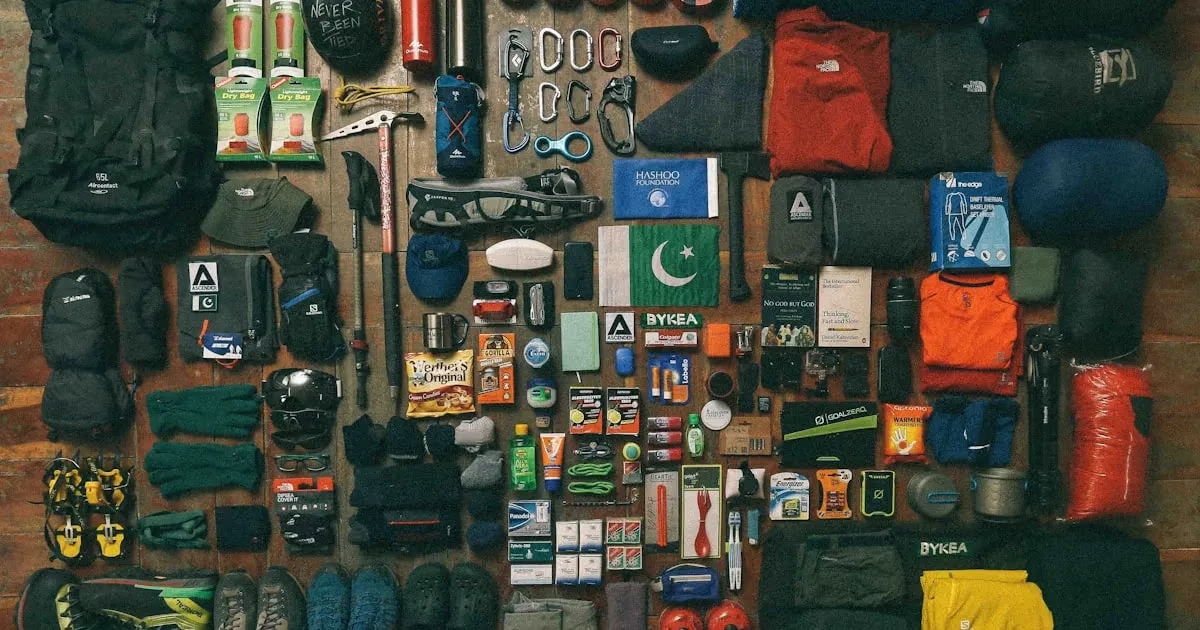
Not going to give you a 150-item list. That’s overwhelming and most of it’s stuff you’ll never use. Here’s what I actually keep after living through five real emergencies and figuring out what I reached for every time.
Used every single time:
- Water (stored plus a purification method)
- Headlamps with batteries
- Battery bank for phone charging
- Cash — $300 in fives, tens, and twenties
- Manual can opener
- First aid kit — the boring stuff. Bandaids. Ibuprofen. Anti-diarrheal tablets. That’s what you actually need.
- Prescription meds, two-week supply, rotated quarterly
- Important documents in a waterproof bag — insurance, IDs, property records
Used sometimes but REALLY glad I had them:
- Camp stove and fuel
- Propane heater
- Battery-powered weather radio. (The one time my phone was dead and a tornado warning went out, that thing probably saved our lives. I am not being dramatic — it was a direct hit on our block.)
- Tarps and duct tape — board up a broken window, cover a leaking roof, improvise basically anything
- Work gloves
- Basic tools — hammer, pry bar, saw, screwdriver set
Packed but never needed (yet):
- Full bug out bag (haven’t had to evacuate from this house, thankfully)
- Fire extinguisher (no fires, but I’ll keep it anyway — my luck would guarantee a fire the day I removed it)
- N95 masks (bought pre-COVID, used during COVID, so I guess they moved up a tier)
Check our water storage calculator to figure out exactly how much water your household needs. It accounts for pets, climate, and activity level, which most generic advice ignores.
The Family Emergency Plan
Having supplies is half the equation. Making sure your family knows what to do when everything goes sideways is the other half. And I’ll be honest — I screwed this part up badly for years.
During Irma, my wife was at her sister’s place in Tampa with the kids. I was at our house in Orlando. The storm hit, cell towers went down for about eighteen hours. I sent probably thirty texts between midnight and 6 AM. None went through. Tried calling. Nothing. Tried the landline at her sister’s house — a number I’d never bothered to memorize and couldn’t look up because the internet was dead.
Eighteen hours of sitting in a boarded-up house listening to the wind rip at the roof with absolutely no idea if my family was okay. My wife was going through the same thing on the Tampa side. Our daughter was four. She kept asking when daddy was going to call.
Everyone was fine. Cell service came back around 6 PM the next day. But those eighteen hours rewired something in my brain.
Here’s what we set up after:
An out-of-state contact made a huge difference for us. My brother-in-law in Michigan. If local towers are jammed or down, long-distance calls and texts often still work. Everyone in the family has his number memorized. Not just in their phone. MEMORIZED. Because phones break. Phones die. Phones end up in a puddle at the bottom of a flooded car.
We set two meeting points. Primary: our house. Secondary: Walmart parking lot on Route 11, about three miles away. If we can’t get to either? Head to the in-laws in Michigan and check in with him along the way.
Check-in times work like this: if separated, everyone texts our contact at 8 AM and 8 PM. Even if it’s just “alive, staying put.” If someone misses two check-ins in a row, he starts calling hospitals.
We also made sure we understood the school’s plan. My daughter’s school has a reunification process. Her teacher has his number too. Probably overkill. Don’t care. After Irma I stopped caring about looking paranoid.
The whole plan fits on one index card. Laminated copies in every wallet, every glove box, and the emergency kit. Total cost: about $4 in lamination at Office Depot. Total time: one family meeting over pizza. No excuse not to do this.
Vehicle Emergency Kit
Your car is probably where you’ll be when something unexpected happens. Or it’s your way out. Either way, keeping basic supplies in the trunk costs almost nothing.
I keep a small duffel in my truck:
- A gallon of water
- Two energy bars
- A space blanket
- Jumper cables
- A flashlight
- Basic first aid kit
- Phone charging cable for the cigarette lighter
- $50 cash
- A printed map of my state (because GPS needs a signal and signals fail — see above)
That kit saved me in 2020 when I hit a deer on a back road in rural Tennessee at about 10 PM. No cell service. Radiator leaking. Twelve miles from the nearest town. Having that flashlight, water, and the presence of mind to just start walking toward the highway — long night. But it would’ve been a LOT worse without the kit.
If you’re interested in navigation when the phone dies, I wrote about wilderness navigation without GPS — different context but the fundamentals apply anywhere.
Mistakes I’ve Made and Mistakes I’ve Watched Other People Make
Eight years of talking to people about this stuff. Certain patterns keep showing up. Here’s the greatest hits of getting it wrong.
Buying gear instead of making a plan is how most people start wrong. I’ve met guys with $5,000 in tactical gear who have never once discussed evacuation routes with their wife. The gear is meaningless if nobody knows where to go or what to do. A $4 laminated index card beats $5,000 in equipment without a plan.
Storing everything in one spot is another one. All your supplies are in the basement? Great. Your house floods. Now what? I split mine between the main floor, the truck, and a small stash at my in-laws’ place.
Forgetting about medications is genuinely dangerous. Someone in your house takes daily meds? You need a two-week emergency supply. Talk to your doctor and pharmacist about getting an extra prescription filled. Most will write one if you explain the reason. During Irma, pharmacies in our area were closed for four days. Four days without blood pressure meds or insulin isn’t a minor inconvenience — it’s a medical emergency.
Then there’s never practicing. You own a fire extinguisher? Have you used one? Do you know how to turn off your home’s water main? Gas main? I didn’t, until a pipe burst in 2021 and I spent twenty minutes Googling it while water sprayed everywhere. Standing in my basement. Soaking wet. Phone in a Ziploc bag. Googling “how to turn off water main.” Twenty minutes. Now I know. Learn this stuff on a boring Tuesday. Not during a crisis.
Letting supplies expire is the last one and it sneaks up on everyone. Batteries die. Water goes stale. Canned food expires. Medications lose potency. I set a reminder every March and September — daylight saving changes — to audit everything. Takes about an hour. Replace what’s old. Charge what’s dead. Verify the plan still makes sense. The plan from three years ago might not match your life today.
On Mindset (Briefly)
I want to be careful here because this topic goes sideways fast. Emergency preparedness is not about fear. Or it shouldn’t be. I know the prepper community has a reputation. Some of it earned. I’ve been to preparedness expos that felt more like doomsday conventions than practical education. Guy in full camo selling bulk ammo next to a woman selling essential oils that “protect against radiation.” That was a weird afternoon.
Here’s my take after actually living through real emergencies: preparedness is boring. The actual event is stressful. The preparation itself? It’s grocery shopping and checking batteries. Having a conversation with your family. Throwing a duffel bag in your trunk.
But the peace of mind? That part is real. When the weather radio goes off at 2 AM with a tornado warning, I’m not panicking. I know where the supplies are. The kids know to go to the basement. Documents are in a waterproof bag by the stairs. My heart’s racing? Sure. But I’m not frozen. And that’s worth the four hours of prep.
Your First Weekend — Start Here
Don’t try to do everything at once. That’s how people get overwhelmed and end up doing nothing. Here’s what I’d knock out in one weekend starting from scratch:
Saturday morning (2 hours):
- Buy seven gallons of water per person ($20-30)
- Buy a headlamp and batteries per family member ($60-80)
- Buy a battery bank and charge it ($20)
- Grab $300 cash from the ATM in small bills
Saturday afternoon (1 hour):
- Gather important documents, photocopy them, waterproof bag
- Check your first aid kit (or buy a basic one for $25)
- Put a manual can opener with your canned food
Sunday morning (1 hour):
- Family plan conversation over breakfast — out-of-state contact, meeting points, check-in times
- Write it on index cards. Laminate if you’re feeling ambitious
- Put a small kit in each car
Sunday afternoon (optional, 1 hour):
- Find your water main shutoff. Turn it off and on so you know how it works
- Find your electrical panel. Know how to kill the main breaker
- Find your gas shutoff (if applicable)
- Test smoke detectors and CO detectors
That’s it. One weekend. Maybe $200 to $300. You’ve just put yourself ahead of roughly 90% of the population. I’m not making that up — FEMA surveys consistently show fewer than half of Americans have even a three-day supply of food and water.
After that? Build as you go. Camp stove. Weather radio. A proper bug out bag. But the basics come first. Always.
Frequently Asked Questions
How much does basic emergency preparedness actually cost? Depends on what you’ve already got. But from absolute zero? About $200 to $300 gets you water, lighting, first aid, a battery bank, and cash reserves. You could spend thousands if you wanted to. But that first $300 covers the stuff that actually matters in the scenarios most people will face.
How often should I update my emergency supplies? Twice a year. I use the daylight saving time changes as my trigger — same time I check smoke detector batteries. Water gets rotated. Expired food gets replaced. Battery banks get recharged. Meds get refreshed.
Do I really need a bug out bag if I plan to shelter in place? Yeah. Because plans change. I “planned” to shelter in place for Irma until the forecast track shifted and suddenly evacuation looked smarter. Having a grab-and-go bag means you’re not stuffing garbage bags at midnight like my buddy Marcus. (Sorry Marcus. Love you. But that story is too good.)
What about generators? They’re useful. Worth considering if you can afford it. But they’re not step one. A decent portable generator runs $500 to $1,000 plus fuel storage costs. Get your basics squared away first. And for the love of everything — OUTDOOR USE ONLY. Carbon monoxide kills people every winter from generators in garages with the door cracked. Don’t be that person.
Should I tell my neighbors about my preps? I go back and forth on this. Community strength matters. But I also don’t love being the neighborhood supply depot when things get bad. What I actually do is help my immediate neighbors get their own stuff together. Share this article. Prep together. A prepared street is safer for everyone on it.
What about pets? Don’t forget them. Extra food. Extra water. Medications if they take any. Copies of vet records and vaccination certificates (some shelters require proof). If you might evacuate, figure out which shelters accept animals — a lot of them don’t. We have a dog and two cats. They’ve got their own section in the emergency bin. My daughter insisted on packing toys for them too. Wasn’t going to argue with an eight-year-old who just wanted her animals to feel safe.
Take our bug out bag essentials quiz to see how your setup stacks up. And for deeper dives on specific topics, we’ve got guides on water purification, shelter building, emergency communication plans, water storage containers, and keeping a vehicle emergency kit in your truck. If you’re working with a tight budget, our guide to prepping for under $100 proves you don’t need thousands to get started. Living in a city? Check out our urban survival tips for apartment preppers. And if you want to prepare for the worst-case grid-down scenario, our EMP preparedness guide covers what actually works.
Go buy some water this weekend. Seriously. Today.
Need a quick-reference version? Download our free 72-Hour Emergency Kit Checklist — a printable, category-by-category list of everything your household needs for the first three days of any emergency.