This article contains affiliate links. We may earn a small commission if you purchase through these links, at no extra cost to you.
Eighteen hours.
That’s how long I went without knowing if my wife and kids were alive during Hurricane Irma. Eighteen hours. I still think about it sometimes when I can’t sleep.
My wife had taken the kids to her sister’s place in Tampa. I stayed at our house in Orlando to board up windows and move stuff off the ground floor. The “plan” — and I’m using that word very generously — was to text each other after the storm passed.
That was it. That was our entire communication plan. “Text each other.”
Cell towers across central Florida went dark around midnight. I sent maybe thirty texts between midnight and 6 AM. None of them delivered. Tried calling. Nothing. Tried the landline at her sister’s house — a number I’d never memorized, couldn’t look up because the internet was dead, and honestly hadn’t even thought about until that moment at 2 AM sitting in a boarded-up house listening to the wind tear at the roof.
My wife was going through the same thing on the Tampa side. Our daughter was four. She kept asking mommy when daddy was going to call.
Everyone was fine. Storm passed. Cell service came back around 6 PM the next day. I cried in the garage when I heard her voice. Then I pretended I didn’t cry. She pretended she believed me.
But those eighteen hours. Man. They changed things. Not in a dramatic overnight way. More like a slow realization that I’d built my family’s safety on the assumption that cell phones always work.
They don’t. If your emergency communication plan relies solely on calling each other on your iPhones, you’re just as vulnerable as I was before Hurricane Irma. Here’s what I developed afterward to avoid the panic and confusion.
Why Cell Phones Fail (And Why It’s Always at the Worst Possible Moment)
Most people think cell phones are basically invincible. They work everywhere, every day, all the time. Until they don’t.
Cell towers have backup battery power. Usually four to eight hours’ worth. After that, if grid power hasn’t come back, the tower goes dark. During a big storm? That’s common. After Irma, some towers in our area were down for three days. During the February 2021 Texas freeze, parts of Houston had no cell service for over a week. A WEEK.
Even when towers stay up, network congestion can make them useless. Everyone in a metro area tries to call at the same time — which is exactly what happens when something goes wrong — and the system chokes. After the 2013 Boston Marathon bombing, cell networks downtown were jammed for hours. Calls wouldn’t connect. Texts sat in queues going nowhere.
Then there’s physical damage. Tornadoes rip out towers. Flooding destroys ground-level equipment. Ice storms bring down the lines connecting towers to the backbone. My neighbor works for a regional carrier. He told me after Irma they had 47 towers down across central Florida alone. Forty-seven. In ONE metro area.
Your Cell Phone Plan Is Not an Emergency Communication Plan
Cell towers have only 4–8 hours of backup battery power. During major disasters, towers go dark and stay dark for days. Network congestion during a crisis often makes functional towers useless anyway. Relying on your smartphone as your only communication method is relying on infrastructure that fails exactly when you need it most. You need a plan for when it fails.
So yeah. Your cell phone is your primary communication tool. But primary doesn’t mean only. You need layers. Redundancy isn’t paranoia — it’s math. One system fails, you have another. That one fails, you have another. Belt and suspenders and maybe an extra belt, as my dad used to say.
Layer 1: The Out-of-State Contact (This One’s Free)
This is the single most important part of any family communication plan. More important than radios. Than satellite phones. Than anything else I’m going to talk about. And it costs zero dollars.
Pick someone who lives far away. At least a few hundred miles. Why? Because local disasters are local. When my cell service was dead in Orlando, my brother-in-law in Grand Rapids, Michigan had fully functional everything. Phones. Internet. Power. His infrastructure was completely fine because the hurricane that wrecked my neighborhood was 900 miles away from his.
Your out-of-state contact is a relay point. If local networks are jammed, long-distance calls and texts often still go through — or at least go through faster. So instead of everyone in your family trying to reach each other through clogged local towers, everyone contacts him. He collects status updates. Relays information. Becomes the switchboard.
During Irma, once service partially recovered the next afternoon, I still couldn’t get through to my wife’s phone. Calls dropped instantly. Local towers were overwhelmed with everyone trying to call everyone at the same time. But I got a text through to my brother-in-law on the second try. He’d already heard from my wife that morning. Everyone was fine.
Found out my family was safe because a guy 900 miles away in Michigan could relay a text message. That’s the power of an out-of-state contact.
Here’s how to set it up (takes about twenty minutes):
- Pick your person. Someone reliable. Someone who answers their phone during a crisis, not the friend who lets everything go to voicemail. Family member is ideal. Close friend works too. Just ask them — most people are happy to help.
- Everyone memorizes the number. Not just stored in your phone. MEMORIZED. Phones break. Phones get lost. Phones die in a puddle in your flooded car. If you can’t remember the number without your phone, the whole plan falls apart. I made everyone in my family practice his number until they could recite it cold. Including my daughter, who was five at the time. She still knows it.
- Check-in times. Ours are 8 AM and 8 PM. Disaster hits, everyone texts or calls our contact at those times. Even if it’s just “alive, safe, staying put.” Three words. That’s all we need. If someone misses two consecutive check-ins, he starts calling hospitals and emergency services.
- Share the important info. He has our home address, car descriptions, insurance info, kids’ school addresses. If he needs to coordinate a search or talk to authorities, he’s got what he needs. That sounds dark. I don’t care. I’d rather be over-prepared than standing in a boarded-up house at 2 AM wondering if my daughter is alive.
Twenty minutes. No gear. No cost. One conversation and some memorization. If you do absolutely nothing else from this article, do this.
Layer 2: Text Before Voice
Congested cell networks still let texts squeeze through way better than voice calls. A voice call needs a continuous open channel for the entire conversation. A text is a tiny packet of data that can slip through gaps in network traffic and queue until bandwidth opens.
First successful communication I had during Irma? A text. Not a call. Same thing during a severe thunderstorm that knocked out local service for a few hours last summer. Calls failed. Texts got through with maybe a ten-minute delay.
So make text your default during emergencies. Keep messages short and packed with information:
“Safe at home. Power out. No injuries. Will check in at 8 PM.”
Eighteen words. Everything your family needs to know. Doesn’t tax the network. Gets through faster.
Also worth knowing: Wi-Fi calling and messaging apps like iMessage, WhatsApp, or Signal can work even when cellular networks are down — IF you have a Wi-Fi connection. Some people had Wi-Fi up during Irma because their internet provider’s infrastructure survived even though the cell towers didn’t. I wasn’t that lucky. But it’s another avenue. And it’s free.
Layer 3: NOAA Weather Radio
A battery-powered NOAA weather radio is probably the most underrated piece of emergency equipment I own. And I talk about it constantly. My friends are tired of hearing about it. I don’t care.
This isn’t for communicating with your family. It’s for incoming information. Weather alerts. Tornado warnings. Evacuation orders. Shelter locations. All broadcast 24/7 by the National Weather Service on NOAA frequencies.
When Irma hit, with no cell service and no internet, my weather radio was the only way I could track the storm’s position and know when it was safe to go outside. It woke me up at 3 AM with a tornado warning — a tornado embedded in the hurricane’s outer bands was headed for our area. I grabbed my daughter’s bike helmet (read that tip somewhere, kept it in the closet), and headed to the interior bathroom with blankets and a flashlight.
Nothing hit us. But knowing the warning existed? That mattered. A lot.
My pick is a Midland WR120B. About $30. Runs on three AA batteries. You can program it for your specific county so you’re not getting blasted with alerts for every watch and warning in the state. The alarm tone is absolutely obnoxious — loud and jarring and impossible to sleep through. Which is, of course, the entire point.
Program Your NOAA Radio for Your Specific County
A NOAA weather radio broadcasts alerts for your entire region — which can include dozens of counties. Program yours to your specific SAME (Specific Area Message Encoding) county code, and you’ll only receive alerts for your actual area. This prevents “alert fatigue” from neighboring county warnings and ensures you wake up for the ones that actually matter. The county code list is available on weather.gov.
Keep it on your nightstand during severe weather. Replace the batteries twice a year. Thirty bucks and some AA batteries for the warning that might save your life. Seems like a reasonable deal to me.
Layer 4: Two-Way Radios (FRS/GMRS)
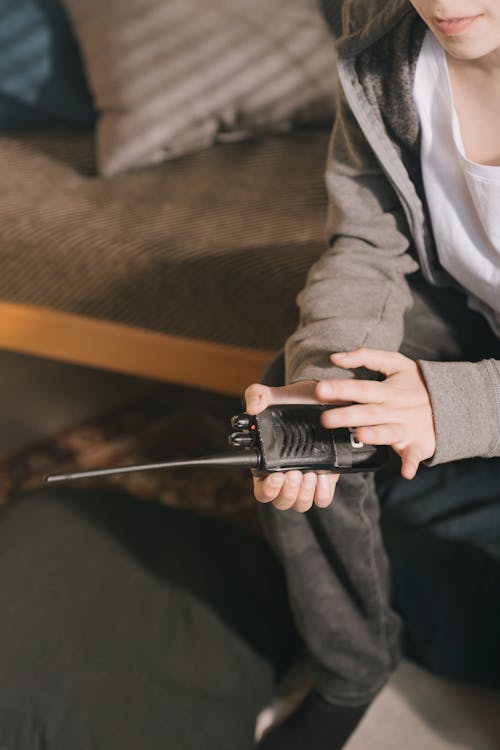
For communicating with family members who are nearby but not with you — different parts of a big property, neighboring houses, a short evacuation distance — handheld radios are a game changer.
FRS (Family Radio Service) radios need no license. GMRS (General Mobile Radio Service) technically requires an FCC license — $35, covers your whole family for ten years, no test required. GMRS gives you more power and better range. Worth the $35 in my opinion.
Got a four-pack of Midland GXT1000VP4 radios. About $60 for the set. Charged, tested, ready to go. Their advertised range is “36 miles” which is, frankly, complete fantasy. In real conditions — trees, buildings, terrain — expect two to five miles. Flat open terrain? Maybe eight. Still plenty for neighborhood-level communication. And that’s all you need.
In the 2019 ice storm, I used these to coordinate with my neighbor Rick (the chicken-nugget griller from my emergency preparedness guide). Checked on him every few hours. Shared information about road conditions. When a tree fell across the road blocking emergency vehicles, we used the radios to coordinate with other neighbors to clear it with chainsaws. All while cell service was barely functioning.
Pre-program a family channel and a backup channel. Write the channel numbers on the communication plan card. Make sure everyone — EVERYONE, including kids — knows how to turn on the radio and press-to-talk. Sounds simple? It is. But I’ve watched grown adults fumble with push-to-talk buttons during stressful moments. A two-minute practice session in the living room prevents that.
Layer 5: Physical Meeting Points
When ALL communication fails — and you should plan for this possibility — physical meeting points give your family a plan that needs zero technology. Nothing to charge. Nothing to break. Just locations.
We have three:
Primary: Our house. Something happens, you can safely get home? Go home. This covers maybe 90% of scenarios.
Secondary: Kroger parking lot on Highway 11. About three miles from home. This covers situations where home is compromised — fire, structural damage, flooding, mandatory evacuation. It’s a well-known location, it’s public, and it’s far enough away to be outside most localized disaster zones. We even specified WHERE in the parking lot — northwest corner, near the garden center entrance. Because “the Kroger parking lot” when you’re stressed and looking for your family in a chaotic parking lot is not specific enough. We learned that. Or rather, I thought about it at 2 AM one night and couldn’t un-think it.
Tertiary: My brother-in-law’s house in Grand Rapids. The nuclear option. Local area is completely gone? Everyone makes their way to Michigan and regroups. Never needed this one. But knowing it exists provides a final backstop. A place to aim for when everything else is gone.
At each point we’ve discussed: where exactly to wait, how long to wait before moving to the next location (24 hours), and what to do if you arrive and nobody’s there (leave a written note — under the wiper blade of whichever car is parked there, or taped to the garden center door).
Our daughter knows all three. She’s nine now. We quiz her occasionally. She rolls her eyes about it, which I take as a sign that she’s absorbed the information. Kids who think the plan is boring have usually memorized it.
Vague Meeting Points Fail in Practice
“Meet at the Kroger” is not a specific enough meeting point. During a stressful evacuation, a crowded parking lot with no clear rendezvous point means family members could be 50 feet apart and miss each other. Specify the exact corner, landmark, or entrance where you’ll wait — and define how long you’ll wait (24 hours is a reasonable window) before moving to the next location.
The Card
Everything above fits on one index card. Both sides. Here’s roughly what ours looks like:
Front:
- Out-of-state contact: [name], [phone number]
- Check-in times: 8 AM and 8 PM
- Primary meeting point: Home
- Secondary: Kroger, Hwy 11, NW corner near garden center
- Radio channel: 7 (backup: 14)
Back:
- Local ICE contacts: [two phone numbers]
- Daughter’s school: [address and phone]
- Insurance agent: [phone]
- Nearest hospital: [address]
- Home address (for emergency responders if you’re disoriented or injured)
Laminated. One in each wallet. One in each car’s glove box. One in the emergency kit. One taped inside the kitchen cabinet. Total cost: about $6 at Office Depot. Time to create: maybe an hour including the family discussion over dinner.
I update it every January. Phone numbers change. Kids change schools. Contacts move. A stale plan is better than no plan. But a current plan is better than a stale one.
What About Satellite Communicators?
I own a Garmin inReach Mini 2. About $400 for the device. Monthly subscription runs $12 to $15 for basic messaging. Sends and receives text messages via satellite — no cell towers needed, works anywhere on Earth with a view of the sky.
Overkill for most people? Probably. I bought it mainly for backcountry trips where cell service doesn’t exist. But during severe weather season, knowing I can message my wife no matter what happens to the local cell network is worth the monthly cost. At least to me. (She thinks it’s excessive. She also thought the weather radio was excessive. Then the tornado warning came. Now she doesn’t comment on my purchases.)
If you spend time in genuinely remote areas — backcountry, offshore, deep wilderness — a satellite communicator is worth thinking about hard. For strictly urban or suburban emergency prep? The other layers I’ve described will cover you without the expense. But if budget allows and peace of mind matters? I’d consider it.
The iPhone 14 and newer models have satellite SOS built in. It’s limited — emergency services and short preset messages, not full conversations — but it’s free and already in your pocket if you’ve got a newer iPhone. That’s something.
Practice It
A plan you’ve never tested is a plan you hope works. I don’t like hope as a strategy. Hope is how you end up grilling chicken nuggets in a bathrobe.
We run a communication drill twice a year. Usually a Saturday morning. Nothing dramatic. I tell the family “we’re doing the drill” and everyone groans and goes about their business in different parts of the house or neighborhood. At the scheduled time, everyone texts our out-of-state contact. He texts back confirmation. We do a quick radio check. Someone walks to the secondary meeting point and back.
Takes maybe an hour. Everyone treats it like a mild annoyance. Which means it’s working — the motions are becoming automatic.
The one time it actually mattered — a severe thunderstorm with a tornado warning last April — My wife grabbed the weather radio and the kids headed to the bathroom without being told. I didn’t have to explain a single thing. The plan just… executed. Because we’d practiced it enough that the responses were automatic.
That’s the goal. Not heroics. Not adrenaline. Just automatic responses that work when your brain is too scared to think straight. That’s what practice gives you.
Frequently Asked Questions
Do I need an out-of-state contact if I have a satellite communicator? I’d still say yes. Satellite devices can break, lose charge, malfunction. An out-of-state contact is a zero-tech solution that works no matter what. It costs nothing. Takes twenty minutes to set up. Belt and suspenders.
What if my family won’t take this seriously? Show them this article. Or better yet — ask them what they’d do right now, today, if cell phones stopped working. Most people have never actually thought about it. Once the question sinks in, the conversation gets easier. She went from “you’re being dramatic” to “okay, let’s make the plan” in about five minutes once she sat with that question.
Should I include neighbors? I think sharing radio channels with trusted neighbors is smart. During the 2019 ice storm, radio coordination with three houses on our street made everything — sharing supplies, clearing roads, checking on elderly neighbors — way more manageable. You don’t need to share your whole family plan. But basic communication with your immediate neighbors has real value.
How do I get my kids to memorize the phone number? Make it a game. Quiz them at dinner. Small reward when they get it right three times in a row. My daughter learned his number in about a week with this approach. She still knows it three years later. Kids are better at memorization than adults give them credit for — they just need a reason to care.
For the bigger picture on emergency planning, read our complete guide to emergency preparedness. And make sure your family has a 72-hour bug out bag ready in case the plan calls for evacuation. You’ll also want a solid first aid kit — because when you’re the one coordinating during an emergency, you might also be the one patching someone up.