This article contains affiliate links. If you buy something through these links, we may earn a small commission at no extra cost to you. We only recommend products we’ve personally used and trust. Full disclosure at the bottom of this page.
Somewhere between Ocala and Gainesville on Route 35. My buddy Marcus and I coming back from a hunting trip with a cooler full of venison in the bed of my F-150.
Then the serpentine belt snapped.
Not frayed. Not worn down gradually. Snapped clean. One second the truck’s running fine, next second the power steering locks up, the battery light comes on, and I’m wrestling the wheel to get us off the road before we lose everything.
We made it to the shoulder. Barely. Almost clipped a mailbox pulling off because without power steering that truck handles like a shopping cart with a busted wheel. Marcus is looking at me like I should know what to do. And I did know what to do. The problem was I didn’t have anything to do it WITH.
No spare belt. No tools beyond a rusty pair of pliers rattling around in the glovebox. No water. No flashlight. We’d been “meaning to” put a kit together for that truck for about three years. Never did.
We sat on the side of that road for four hours waiting for Marcus’s wife to drive out from Tampa. FOUR HOURS. In November, which in Florida still means 85 degrees and mosquitoes the size of hummingbirds. We drank the melted ice water from the cooler. That’s how unprepared we were.
Second time was worse. February 2021, driving through the mountains outside Asheville visiting my cousin. Hit a patch of black ice coming down a grade, slid into a ditch. Nobody hurt, truck wasn’t damaged, but we were stuck. In 28-degree weather. At 9 PM. With a quarter tank of gas and no cell service.
That one scared me. Really scared me. Not the accident — the realization that if things had gone slightly different, if someone had been hurt, if the truck had rolled, we had NOTHING to deal with it.
So yeah. I built a kit. Not one of those cute little red bags you buy at Walmart for $29.99 that has a rain poncho and some band-aids. A real kit. One that’s kept me and other people out of serious trouble multiple times since.
Here’s exactly what’s in it and why.
The Container Matters More Than You Think
First thing — forget those nylon bags. They look nice on Amazon but within six months in a hot vehicle they smell like mildew, the zippers break, and everything inside is a jumbled mess.
I use a Plano 1819 storage trunk. The big one. $47 at Bass Pro. It’s waterproof, stackable, and has latches that actually work even after sitting in 140-degree truck bed heat all summer. I’ve had the same one for four years now. Still works perfect.
If you’ve got a smaller vehicle, the Plano 1712 works too. About half the size. Around $32 at most sporting goods stores.
Everything goes in gallon Ziploc bags inside the trunk. Even stuff that’s already “waterproof.” Trust me on this. I found out the hard way that waterproof ratings on cheap flashlights mean basically nothing when they’ve been sitting in condensation for three months.
Tier One: The Stuff That Saves Your Life
Gear that stays in the truck 365 days a year. Never comes out. Never gets borrowed. Never gets “I’ll put it back later.”
Water goes in first, always. Four one-liter bottles of Dasani — not gallon jugs, which split and leak in the heat. Individual bottles, factory sealed. I rotate them every six months and write the date on them with a Sharpie so I actually remember. If you’ve ever built a 72-hour bug-out bag, you know water is always item number one.
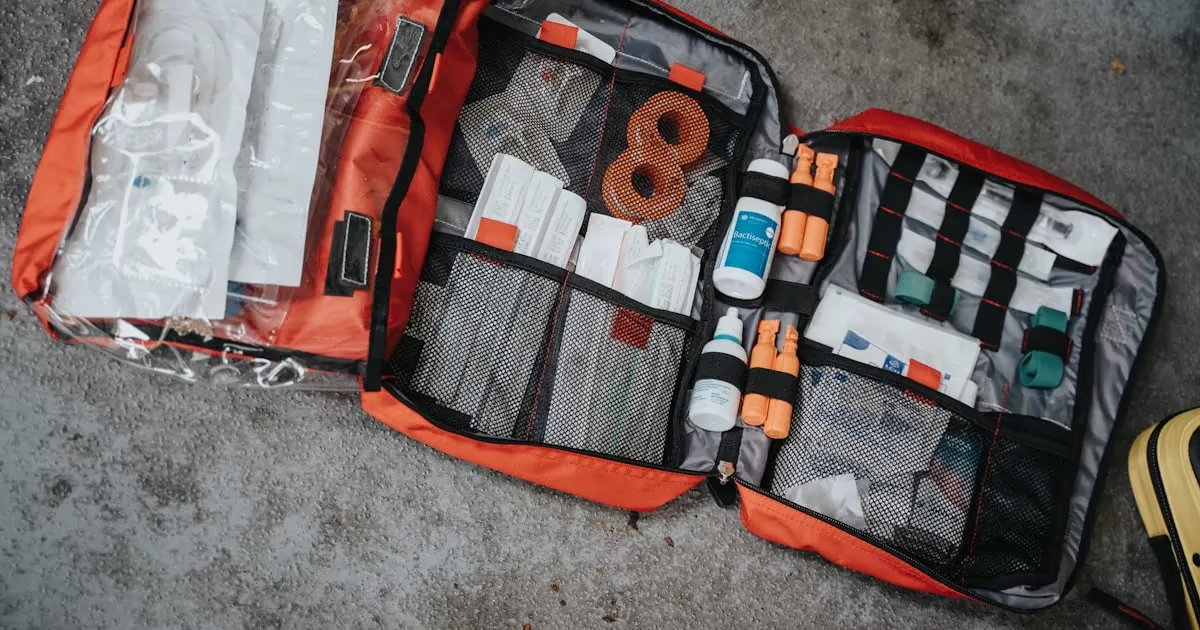
For the first aid kit, skip the Walmart special. I built mine from scratch and wrote a whole separate guide on how to do it right. The short version: Israeli bandage, QuikClot gauze, a CAT tourniquet, ibuprofen, Benadryl, and actual medical tape — not the dollar store kind that unsticks if you sweat on it.
I carry a Streamlight ProTac 2L-X ($55) and a Petzl Actik headlamp ($35). The headlamp is the more important one, honestly — try changing a tire in the dark while holding a flashlight in your mouth. It’s not fun. Spare batteries for both, stored separately in a Ziploc.
For fire-starting I keep a Bic lighter, stormproof matches in a waterproof case, and a ferro rod. Three ways to make fire because fire does a lot of things — heat, signaling, morale. If you want to go deeper on fire methods, I put together a guide on starting fire without matches that covers the ferro rod technique.
My go-to knife in this kit is a Morakniv Companion — $15, best knife value on the planet and I will fight anyone who disagrees. I keep it in a Ziploc bag because the sheath is friction-fit and things shift around in a truck bed.
Skip the crinkly mylar emergency blankets. I use a SOL Heavy Duty Emergency Blanket instead — $8 on Amazon, big enough to actually wrap around an adult. The regular mylar ones rip if you look at them funny. After my Asheville experience, I don’t play around with cold weather gear in vehicles. If you want more on that topic, check out our piece on emergency preparedness fundamentals.
Keep Your First Aid Kit in the Passenger Cabin — Not the Trunk
If you’re in an accident serious enough to need the first aid kit, the trunk or bed may be crumpled and inaccessible. Store at minimum a bleed-control kit — tourniquet, pressure bandage, QuikClot gauze — in the glove box or center console where you can reach it regardless of how the vehicle is damaged. The big kit can live in the bed; the critical trauma supplies need to be within arm’s reach.
Tier Two: The Stuff That Keeps You From Being Miserable
Don’t buy the skinny 12-gauge jumper cables from the gas station. I run 4-gauge, 20-foot cables — $38 at AutoZone and worth every penny because they actually work on trucks and SUVs, not just Honda Civics.
Tire repair kit. A plug kit, not just Fix-A-Flat. The ARB Speedy Seal kit is $22 and I’ve plugged six tires with it. Takes about ten minutes once you’ve done it a couple times.
12V air compressor. A Viair 88P. Around $45. Plugs into your cigarette lighter and actually fills a full-size truck tire in about eight minutes. The cheap ones at Walmart take 30 minutes and overheat halfway through.
A tow strap is non-negotiable — 30-foot, rated for 30,000 pounds minimum. Don’t buy one that’s rated for less than your vehicle weighs. I got mine for $29 at Tractor Supply. One critical detail: get loop ends, NOT hooks. Hooks under tension become projectiles when they break, and they do break.
Get Loop-End Tow Straps, Not Hooks
Tow strap hooks under tension can snap off and become projectiles moving at serious speed. The same failure with loop ends is just a strap falling to the ground. Always buy tow straps with sewn loop ends, and never stand behind a vehicle being towed. This is the most common tow strap safety mistake, and it has caused real injuries.
Multi-tool. A Leatherman Wave+. $90 and worth every cent. The pliers alone have gotten me out of more situations than I can count.
I wrap about 15 feet of duct tape around an old gift card. Takes up almost no space and duct tape is duct tape.
Tier Three: Seasonal and Situational Stuff
What I add or remove depending on the time of year and where I’m driving.
Winter additions: Wool blanket (a real one, not fleece — $25 at an army surplus store), hand warmers (a 10-pack from Costco), a folding snow shovel, ice scraper, and a bag of cat litter for traction. If I’m driving in actual snow country I also throw in my insulated Carhartt bibs.
Summer additions: Extra water (I go from four bottles to eight), sunscreen, bug spray, a wide-brim hat, and electrolyte packets.
Long trip additions: A USB battery bank (Anker 26800mAh, $45), a paper map of the area (yes, paper — phones die and GPS fails), a change of clothes in a dry bag, and cash. At least $200 in mixed bills. ATMs don’t work when the power’s out.
Where to Put It All
Placement depends on your vehicle but the rule is: accessible WITHOUT unloading your entire car.
In my F-150, the big Plano trunk lives against the cab wall of the bed, strapped down with ratchet straps. The first aid kit and flashlight are in the back seat, because if I’m in an accident and the truck bed is crumpled, I need those accessible.
If you drive a sedan, trunk is fine for the main kit but keep a small pouch with the flashlight, first aid basics, and a window breaker in the center console or glove box.
And for the love of everything — keep a window breaker and seatbelt cutter mounted somewhere you can reach from the driver’s seat. The ResQMe tool is $12 and clips right onto your visor. If your car goes into water you have about 60 seconds before the electronics short and the windows won’t roll down. Sixty seconds.
Mount a Window Breaker Where You Can Reach It Belted In
A window breaker stored in your trunk is useless if your car goes into water. The ResQMe tool ($12) clips to your visor and puts a glass breaker and seatbelt cutter within reach of your driver’s seat. In a water submersion scenario, you have roughly 60 seconds before electronics short and windows won’t roll down. This $12 tool has a different risk profile than everything else in your kit.
The Stuff Nobody Thinks About
If you take daily meds, keep a three-day supply in the kit and rotate them monthly. My wife takes thyroid medication and we keep a small pill case with five days’ worth in each vehicle.
Paper documents are also worth carrying — copies of your insurance, registration, ID, and emergency contacts, laminated and in a Ziploc. Your phone might be dead. Your wallet might be in the car that just caught fire. Having paper copies has saved people.
One roll of toilet paper in a Ziploc bag. You’ll thank me.
A pen and small notepad. For exchanging info after accidents, leaving notes on vehicles, writing down mile markers when you’re trying to describe your location to a tow truck dispatcher who’s asking questions you can’t answer because you weren’t paying attention to the road signs.
What NOT to Pack
I see these in “vehicle emergency kit” lists all the time and they’re either useless or dangerous:
Traditional road flares, the kind with the striker cap, are a headache. They expire, they’re a fire hazard in a hot vehicle, and LED road flares are $20 for a set of three and last forever. Get the LED ones.
Cans explode in hot cars. I’m serious — I left a can of Dinty Moore beef stew in my truck in July once. It expanded, the seam split, and my truck bed smelled like dog food for two weeks. Use granola bars, energy bars, or emergency ration bars instead. I keep six Clif Bars in a Ziploc and rotate them every three months.
A full-size spare tire. Unless your vehicle came with one. Most modern trucks and SUVs still have a full spare underneath, but if yours doesn’t, that plug kit and air compressor will handle 90% of tire situations.
Total Cost and How to Build It Over Time
All in, my complete kit runs about $475. That sounds like a lot until you remember that one tow truck call costs $150-300 and one night in an ER costs your deductible.
But you don’t have to buy it all at once. Here’s how I tell people to do it:
First month ($85): Water, first aid supplies, flashlight, headlamp, knife, emergency blanket, and the container.
Second month ($75): Jumper cables, tire plug kit, duct tape, Ziploc bags, toilet paper, documents.
Third month ($90): Air compressor, tow strap, multi-tool.
Fourth month ($45): Battery bank, paper maps, cash reserve.
Then seasonal stuff as needed. Spread it out. Build it right.
Actually Check Your Kit
Here’s where most people fail. They build the kit, throw it in the truck, and forget about it for two years.
Set a reminder on your phone. Every six months. I do mine on the spring and fall time changes because I can remember that.
Check expiration dates on food and medicine. Replace the water. Test the flashlight batteries. Make sure the first aid supplies haven’t gotten moisture damage. Check that the jumper cable clamps aren’t corroded.
Takes about 20 minutes twice a year. That’s 40 minutes of annual maintenance to keep yourself from being the guy sitting on the side of Route 35, drinking cooler water, waiting four hours for a ride.
Don’t be that guy. I was that guy. It’s embarrassing.
Your vehicle kit is one piece of the puzzle. Make sure you also have a 72-hour bug out bag at home and a get home bag at work. And for the overall game plan, our complete guide to emergency preparedness ties everything together. If you drive in winter, our cold weather survival guide covers what to do if you’re stranded when temps drop.