This article contains affiliate links. We may earn a small commission if you purchase through these links, at no extra cost to you.
A 12-acre parcel in the foothills of the Smoky Mountains. No power lines. No water hookup. No sewer. The nearest paved road was a quarter mile of gravel away and the cell signal was one bar if you stood on the porch and held your phone above your head at a specific angle that my wife called “the Statue of Liberty.”
We’d just closed on the property. Standing there in the weeds looking at a clearing where a cabin was going to go eventually. She turned to me and said “So how do we… do anything?”
Good question.
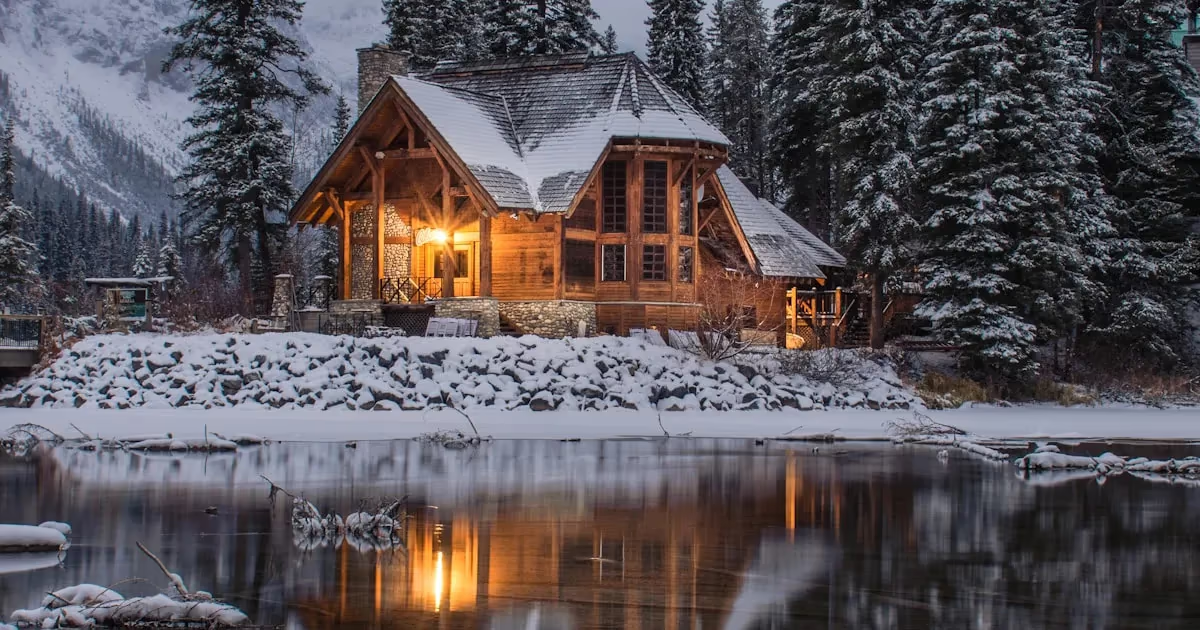
That was four and a half years ago. Today we have a 1,200-square-foot cabin with a full solar power system, rainwater collection, a composting toilet that works better than you’d think, a wood stove, a chest freezer full of venison and garden produce, and internet through Starlink. Our monthly bills are basically the Starlink subscription and property taxes. That’s it.
But getting here cost more money, more time, and more problem-solving than any of the YouTube homesteading channels prepared me for. So let me give you the version they don’t show. The version where things break, plans fail, and you spend a Tuesday afternoon troubleshooting why your inverter is making a sound it shouldn’t be making while your phone is at three percent and the nearest electrician is forty minutes away.
The Money Question Everyone Asks First
“How much does it cost to go off-grid?” Depends on what you mean by off-grid and what your comfort expectations are. But I’ll give you our numbers because I tracked everything.
Land: we paid $47,000 for twelve acres with road access and a year-round creek. That’s Tennessee pricing. In Montana or Colorado you’d pay double or triple. In rural Missouri or Arkansas you might pay half.
Cabin (owner-built, basic): $38,000 in materials. I did about seventy percent of the labor myself with help from my father-in-law and a couple of buddies. If you hired everything out, multiply by three.
Solar power system: $12,500 for a 3.6kW system with lithium battery bank. More on this below.
Water system: $4,200 for rainwater collection, filtration, and pressure tank.
Composting toilet: $1,800 for a commercial unit. You can build one for a few hundred bucks but we wanted something that my wife would actually use without complaining. That narrowed the options.
Wood stove and chimney: $2,800 installed.
Miscellaneous (septic for greywater, driveway gravel, tools, permits, surprises): $8,000.
Total all-in: Roughly $115,000. Over two years.
That’s a lot of money. But our old house payment was $1,450 a month. No mortgage on the cabin. No electric bill. No water bill. No gas bill. Monthly expenses dropped to maybe $200. At that rate, the savings cover the investment in about five years. After that, it’s just… freedom.
Off-Grid Doesn't Have to Be All or Nothing
You don’t have to do everything at once. Many people start by adding solar panels to a mortgaged rural property, then gradually add water systems and eliminate utilities over years. Each step reduces monthly expenses and builds the skills you need for the next one. A phased approach costs less upfront and lets you learn before committing fully.
Watch: Building an Off-Grid Cabin from Start to Finish
Solar Power: The Heart of the System
Going off-grid means you need electricity. You technically don’t NEED it, but you probably want lights, a fridge, a chest freezer, phone charging, a laptop, and maybe a washing machine. All of that runs on solar if you size the system right.
Here’s what we run:
- LED lighting throughout the cabin
- An energy-efficient chest freezer (runs about 1 kWh per day)
- A standard-size refrigerator (about 1.5 kWh per day)
- Laptop and phone charging
- A washing machine (front-loader, about 0.5 kWh per load)
- Small appliances — coffee grinder, food processor, occasionally a vacuum
What we DON’T run on solar: air conditioning, electric heat, an electric dryer, an electric stove, or a hair dryer. Those are power hogs that would triple the system cost. We dry clothes on a line. We cook on propane. We heat with wood. Those choices kept the solar system affordable.
Our system: twelve 300-watt solar panels (3.6 kW total), an MPPT charge controller, a 48V lithium iron phosphate (LiFePO4) battery bank at 15 kWh capacity, and a 5,000-watt pure sine wave inverter. Total cost including wiring, mounting, and a transfer switch: about $12,500 in 2022 prices. You might pay less today as panel prices keep dropping.
To size your own system, start by listing every electrical device you’ll use and how many hours per day you’ll run it. Multiply watts by hours to get watt-hours. Add it all up. That’s your daily energy need. Ours is about 8 kWh on a typical day. A 3.6 kW solar array in Tennessee with five good sun-hours per day produces about 14-18 kWh in summer, 7-10 kWh in winter. Winter is always the constraint. Size for your worst season, not your best.
The battery bank is where the real cost lives. Lithium batteries are expensive but last ten to fifteen years and handle deep discharges without damage. Lead-acid batteries are cheaper upfront but last three to five years, weigh four times as much, and can only be discharged to fifty percent without shortening their life. I went lithium. It was more money but I won’t be replacing them for a decade. My neighbor Tom went with lead-acid golf cart batteries and he’s already on his second set.
One thing a lot of people skip until it’s too late: a generator backup. Not as your primary power source — that defeats the purpose — but for those week-long stretches of overcast winter weather when the sun doesn’t show up and the batteries drain down. We have a 3,500-watt dual-fuel generator that runs on propane or gas. We fire it up maybe ten to fifteen times a year. Sometimes less. But when you need it, you NEED it.
Always Budget for a Backup Generator
A week of overcast winter weather can drain even a well-sized battery bank. A 3,000-4,000 watt backup generator ($500-$1,000) isn’t a failure of your solar system — it’s essential insurance. Budget it into your initial system cost rather than scrambling for one later when batteries are at 10% and there’s a storm outside.
If you’re building out emergency preparedness, an off-grid solar setup doubles as the most robust backup power system money can buy. Grid goes down, your lights stay on. Not a bad position to be in.
Water: More Complicated Than You’d Think
Water was the system I underestimated most. We have a year-round creek on the property, which I naively thought meant water was “handled.” It was not handled. Creek water needs serious filtration before you drink it. And getting it from the creek to the cabin requires a pump, which requires power, which circles back to the solar system.
Rainwater collection became as our primary source. Here’s the setup:
For collection, our 1,200-square-foot metal roof brings in about 750 gallons per inch of rainfall. Tennessee gets roughly 50 inches of rain per year, so theoretical annual collection is around 37,000 gallons. Actual collection after losses is more like 25,000-30,000 gallons. A two-person household uses maybe 50 gallons per day, or about 18,000 gallons per year. So the math works, with a buffer.
We store it in two 2,500-gallon polyethylene tanks on a gravel pad slightly uphill from the cabin, gravity-fed to a pressure tank in the utility room. Total storage of 5,000 gallons gets us through about three months without rain, which has never actually happened but it’s nice knowing we could.
Filtration is a three-stage system: sediment filter first, then a carbon block filter, then UV sterilization. The whole setup cost about $600 for the filters and UV unit. Replace the filters every six months, the UV bulb once a year. Our water tests cleaner than the municipal supply in Knoxville. I’m not exaggerating — we had it lab-tested.
First flush diverter. This is a device on each downspout that diverts the first few gallons of rainfall — which carries bird droppings, pollen, and roof debris — away from your storage tanks. Twenty bucks each. Non-negotiable if you’re drinking roof water.
Install First Flush Diverters on Every Downspout
The first few gallons off your roof during a rain carry concentrated bird droppings, pollen, and debris. A first flush diverter ($15-$25 each) automatically diverts this contaminated water away from your storage tanks and only lets clean water in after the roof is rinsed. This is the single cheapest and most effective water quality upgrade you can make to a rainwater system.
For more on water storage and filtration, the same principles I cover in emergency water storage and field water purification apply here, just scaled up.
Heating: Wood Stove Is King
Heat comes entirely from wood. A Drolet HT3000 high-efficiency wood stove rated for 2,700 square feet — overkill for our 1,200-square-foot cabin but that means we never have to run it wide open. It coasts along at medium and keeps the whole house in the 70s even when it’s 15 degrees outside.
We burn about four cords per winter — a cord being a stack four feet by four feet by eight feet. I cut and split it all from standing dead timber on our property. Takes me about four weekends in late summer and fall to put up a winter’s worth. Chainsaw, splitting maul, some sweat. It’s exercise.
If you’re buying wood instead of cutting your own, a cord runs $200-350 depending on where you live. Four cords at three hundred is twelve hundred bucks for a whole winter of heat. That’s less than most people’s gas bill, but it’s not nothing.
One thing I can’t stress enough: chimney installation matters as much as the stove. Triple-wall insulated chimney pipe through the roof. Proper clearances to combustibles. A spark arrestor on top. This is not the place to cut corners. House fires from improper wood stove installation are common enough that our insurance company sent an inspector out before they’d write the policy.
Never Cut Corners on Wood Stove Chimney Installation
Improperly installed chimneys are a leading cause of house fires in off-grid and rural homes. Use triple-wall insulated chimney pipe, maintain proper clearances to combustibles, install a spark arrestor on the cap, and have the installation inspected. A $200 inspection is cheap insurance compared to losing a cabin you built yourself.
Waste: The Glamorous Side of Off-Grid
Nobody talks about this part on Instagram. But you have to poop somewhere, and without a sewer connection, your options are a septic system or a composting toilet.
A full septic system — tank, drain field, permits, installation — runs $8,000-15,000 depending on soil type and local codes. That’s a lot of money to flush a toilet.
We went with a composting toilet for human waste and a small greywater septic for sink and shower water. The composting toilet was a commercial Nature’s Head unit. No water. No smell if you maintain it properly. You add coconut coir or peat moss as a bulking agent, turn a handle to mix it, and empty the solids container every four to six weeks. The liquid goes into a separate container that you empty every few days.
Does it sound weird? Yes. Did it take some adjustment? Also yes. My wife was skeptical for the first month. Now she says she prefers it to a regular toilet because there’s no water waste and the bathroom never smells. I think she’s overselling it slightly but she’s not wrong about the no-smell part.
Internet: Starlink Changed Everything
Before Starlink, off-grid internet meant cellular hotspots (expensive, slow, unreliable) or satellite internet from HughesNet or Viasat (expensive, slow, terrible latency). Starlink changed the equation completely.
Monthly cost is $120. We get 100-200 Mbps download speeds. The latency is low enough for video calls. I work remotely three days a week through this connection. My wife streams shows in the evening. It just works.
The dish needs a clear view of the northern sky. That meant cutting three trees on our property. Worth it. The dish draws about 75 watts on average, which our solar system handles without issue.
If you’re considering off-grid living but need internet for work, Starlink is the answer. It’s not cheap but it removes the single biggest objection most people have about living remote.
The Honest Downsides Nobody Mentions
I love our life out here. But I’d be lying if I said there weren’t tradeoffs.
Everything becomes your problem. Power goes out? That’s you. Water stops flowing? That’s you. Something breaks at 11 PM on a Sunday? No landlord to call. No utility company to dispatch a crew. YOU are the crew. Last February our inverter threw a fault code at 6 AM. Fourteen degrees outside. No power. I spent two hours troubleshooting in the cold with a headlamp and a multimeter before I found a loose connection on the battery terminal. Fixed it. Made coffee. Went to work. Never told my wife because she was asleep the whole time and I didn’t want to worry her.
Isolation is real. Our nearest neighbor is a quarter mile away. The nearest grocery store is twenty minutes. The nearest hospital is forty-five minutes. That’s fine ninety-nine percent of the time. The one percent is nerve-wracking. We keep a well-stocked first aid setup and my wife took a wilderness first aid course. That helps.
The initial cost is front-loaded. You spend a LOT of money upfront to save money every month forever. If you don’t have savings or the ability to build slowly, it’s a hard entry point. Some people go off-grid gradually — solar first, then water, then build out over years. That’s a legitimate approach.
Social life changes. Friends don’t “just stop by” when you live thirty minutes from town on a gravel road. You have to be intentional about maintaining relationships. We drive to town for dinner with friends. We host people at the cabin. But the spontaneous social stuff that happens when you live in a neighborhood — that goes away.
Is Off-Grid Living Right for You
I think about this question honestly because I’ve watched people try it and quit within a year. The ones who quit usually fell into one of two categories: they romanticized it from watching too many YouTube videos, or they underestimated the workload.
Off-grid living is not a vacation. It’s a full-time relationship with your infrastructure. Wood needs splitting, filters need changing, batteries need monitoring, gardens need tending, things need fixing. It’s deeply rewarding work but it IS work. Every day. No breaks.
It works best for people who like solving problems, don’t mind physical labor, and derive satisfaction from doing things themselves. Anyone who hates fixing stuff, this life will make you miserable.
My advice: start with the skills before you buy the land. Learn to build a fire. Take a wilderness survival course. Get your emergency preparedness dialed in. Grow a garden. Fix something with your hands. If all of that feels good — feels like something you want MORE of — then off-grid might be your thing.
It’s ours. Four and a half years in and I can’t imagine going back. Even when the inverter breaks at 6 AM in February.
If you’re ready to dig into the details, our guide on sizing a solar power system covers the real math behind panels, batteries, and inverters. And for water independence, our rainwater harvesting guide walks through everything from first catchment to a 3,000-gallon-per-month system.