This article contains affiliate links. If you buy something through these links, we may earn a small commission at no extra cost to you. We only recommend products we’ve personally used and trust. Full disclosure at the bottom of this page.
Hurricane Irma again. But this time I’m not at home.
I’m at work. Thirty-one miles from my apartment in Tampa. It’s 2 PM on a Thursday and my boss just came out of his office and said go home. Now. Right now. The storm shifted and it’s coming straight at us and the governor just upgraded the evacuation order.
Great. Thirty-one miles. Normally a forty-minute drive. Google Maps says two hours and eighteen minutes because every single person in Hillsborough County is doing the same thing at the same time.
I made it home in three hours and twelve minutes. But here’s the thing that kept eating at me for weeks afterward. What if I hadn’t?
What if the highways gridlocked completely — which they did in some areas. My car could have overheated in traffic — which happened to the guy two cars ahead of me on I-275. What if I had to abandon the car and walk? Thirty-one miles. In dress shoes. With a quarter bottle of water and a Clif Bar wrapper from two weeks ago.
Had nothing.
My bug out bag was at home. Obviously. That’s where bug out bags live. They sit in your closet or your hallway waiting for you to grab them on the way out the door. But what happens when you’re NOT at the door? What happens when you’re at your desk, or at a job site, or picking up your kid from soccer practice 20 miles away, and everything falls apart and you need to get home first?
That’s what a get home bag is. And almost nobody has one.
It’s Not a Bug Out Bag
This is the first thing I need to clear up because I see people on forums constantly confusing the two. And I get it — they look similar. Bag full of survival stuff. What’s the difference?
The difference is everything.
A bug out bag is designed to sustain you for 72 hours while you travel FROM home TO somewhere safe. You’re leaving home. You’ve got your full kit. It weighs 25 to 35 pounds because it has three days of food, water purification, shelter, sleeping gear, the works.
Your get home bag is designed to get you FROM wherever you are BACK to home. You’re going home. You probably don’t need three days of food. You probably don’t need a sleeping bag. What you need is to cover 10 to 40 miles on foot if necessary, in whatever clothes you were wearing when everything went sideways, as fast and as safely as possible.
Different mission. Different bag. Different mindset.
My get home bag weighs 11 pounds. My bug out bag weighs 28. That’s not an accident. The GHB lives in my truck every single day. I don’t notice it. I don’t think about it. It’s just there, behind the passenger seat, being ignored — until I need it.
A GHB Is Not a Miniature Bug Out Bag
A bug out bag sustains you for 72 hours moving away from home. A get home bag is optimized for a single mission: covering 10-40 miles on foot to reach home. You don’t need a sleeping bag, a week of food, or camp gear. You need shoes, water, a map, and enough calories to walk hard for one day.
The Bag
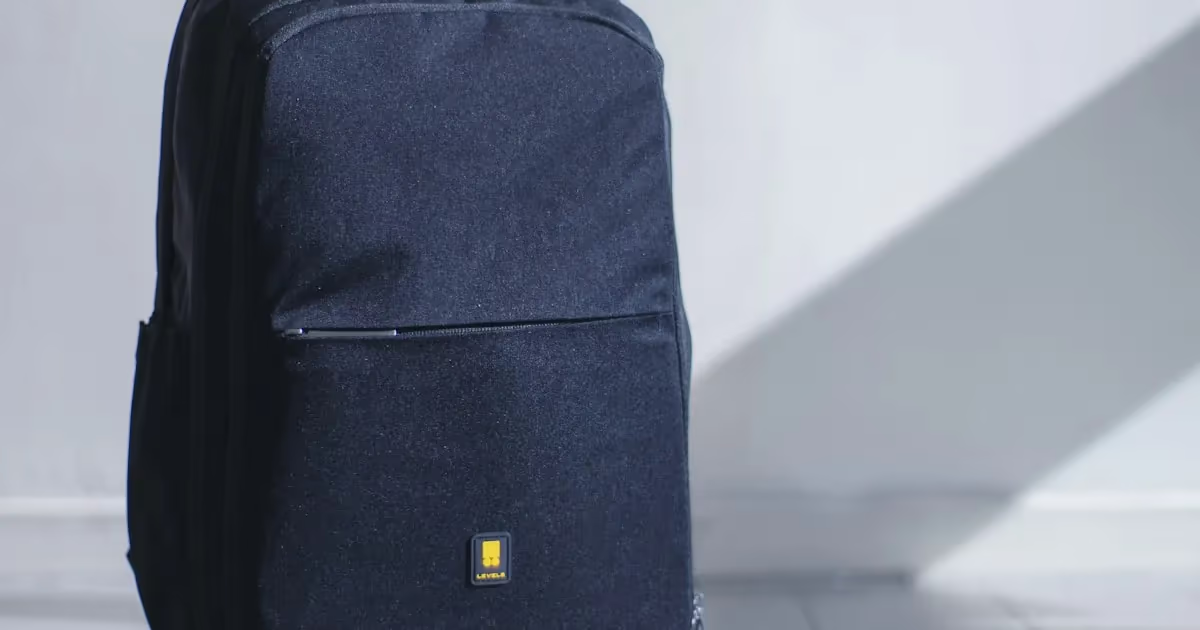
Small. Seriously, small. A regular daypack. 20 to 25 liters max. Nothing tactical. Nothing that screams “THIS PERSON HAS SUPPLIES.” Mine is a gray Jansport that looks like something a college kid would carry. On purpose.
Gray man theory. During an emergency, you do not want to be the person who clearly has stuff when nobody else does. That invites attention. The wrong kind of attention. I watched a guy during the Irma evacuation walk through a gas station parking lot wearing full tactical gear — plate carrier, MOLLE vest, the whole thing — and the looks he was getting from people were not admiration. They were assessment. As in, “that guy has things I might need.”
Be the boring person with the boring backpack. Get home quietly.
Water (But Not Much)
Not living out of this bag for a week. You’re covering a distance. For most people, that distance is 10 to 30 miles. Walking, that’s anywhere from 4 to 10 hours depending on your pace and the terrain.
Pack a 32-ounce Nalgene bottle. Filled. That’s a pound of water. Enough for a hard half-day of walking if you’re not in extreme heat.
Also a Sawyer Squeeze. Thirty bucks, two ounces, fits in a pocket. If your commute takes you past any water source — creek, river, pond, public fountain, whatever — you can refill. In an urban environment, most buildings have exterior spigots. Gas stations have bathroom sinks. Water is findable. What’s not findable is clean water, and the Sawyer handles that.
Don’t pack water bottles. One hard-sided bottle and a filter. That’s it. Every ounce matters when you’re walking double-digit miles in dress shoes. Speaking of which.
Shoes. THE Most Important Thing in This Bag.
Can’t believe how many get home bag articles I’ve read that don’t mention shoes until item fifteen. Shoes are item ONE.
You might be wearing loafers. Heels. Steel-toed boots that weigh three pounds each. Sandals. I know a guy — Andrew, works in sales — who was wearing flip-flops when a tornado warning hit his office in 2019. Flip-flops. Try walking fifteen miles in flip-flops. Actually, don’t.
A pair of broken-in sneakers or lightweight hiking shoes. Broken in. NOT new. I put a pair of Merrell trail runners in my bag — $65 on sale at REI, and I wore them on three weekend hikes before they went in the bag. They weigh 22 ounces for the pair. I know they fit. I know they don’t give me blisters. I know I can cover 15 miles in them without destroying my feet.
Pair of wool hiking socks rolled up inside the shoes. Darn Tough brand. About $22. Your feet are your transportation. Treat them like it.
Every six months, take the shoes out and try them on. Feet change. Shoes compress. The $65 trail runners that fit perfectly a year ago might pinch now, and you do NOT want to discover that at mile three of a twelve-mile walk.
Test Your Bag by Actually Walking Home
The only way to know if your GHB is right is to use it. Pick a Saturday, drive to work, and walk home wearing the bag. You will learn more in one walk than in years of reading forum posts. Most people discover their shoes don’t fit, they need more water, and their route through downtown is terrible. Fix those things before a real emergency forces the test.
Food (Just Enough)
You’re not setting up camp. You’re moving. Pack food that you can eat while walking.
Four Clif Bars. About $6 total. 250 calories each. That’s 1,000 calories. Enough to fuel a hard day of walking. They don’t melt in a hot car (well, they get soft, but they don’t disintegrate like chocolate). They don’t freeze in winter. They last about a year before they start tasting like cardboard, and honestly they kind of already taste like cardboard, so the transition is seamless.
Two packets of electrolyte powder. Liquid IV, LMNT, whatever. About $3. When you’re sweating through a ten-mile walk in July — and in Florida, July means you’re sweating through everything — you need electrolytes, not just water. I learned this the hard way on a training walk I did in 2019 to test my GHB. Walked 18 miles from my office to my apartment. By mile 14, my calves were cramping so badly I had to stop every quarter mile. Should’ve had electrolytes.
Small tube of peanut butter. The squeeze tube ones. Two bucks, 400 calories, no utensils needed. Squeeze it in your mouth while walking. Undignified? Sure. Effective? Absolutely.
Navigation
Your phone might be dead. Cell towers might be down. GPS might not work.
Paper map of your area. Specifically, a map showing your commute route AND two alternate routes home. I printed mine from Google Maps on regular paper and laminated it at the FedEx store for $3. Folded it into a square and stuck it in the side pocket of the bag. It’s been there for four years.
Mark three things on that map. Your work. Your home. And a halfway point where you could shelter if you needed to — a friend’s house, a church, a fire station, whatever. My halfway point is my buddy Steve’s house in Carrollwood. I called him and said hey, if the world ends and I’m walking home, can I crash at your place for a few hours? He said yes and also asked if I was okay. Fair question.
Toss in a small compass. The Silva Starter costs $10. Overkill for urban navigation? Maybe. But when you’re cutting through neighborhoods you don’t know because the main road is gridlocked or flooded, knowing which direction is generally “toward home” matters.
Light
Pack a headlamp. AAA batteries. The Petzl Tikkina is $20 and weighs 82 grams. Your walk home might start at 3 PM. It might still be going at 10 PM. Walking through unfamiliar areas in the dark without a light is how you step in a hole, twist an ankle, and turn a ten-hour walk into an overnight ordeal.
Extra AAA batteries. One set. Ziplock bag. $3.
First Aid (Focused)
You don’t need a comprehensive first aid kit. You need a walking-specific first aid kit.
Blister treatment. Moleskin, Leukotape, or Second Skin. This is the number one injury you will face walking 10+ miles in non-ideal footwear. I got a blister on my right heel at mile 6 of my test walk and spent the remaining 12 miles limping. A $4 pack of moleskin would have prevented that entirely.
Ibuprofen. Twenty tablets in a small ziplock. For the inevitable aches, blisters, headache, whatever. Not medical advice. I’m not a doctor. But 400mg of ibuprofen at mile 8 is the difference between walking and not walking.
Four alcohol prep pads and four adhesive bandages. Small cuts from climbing fences, stepping through brush, or whatever obstacles appear between you and home.
Athletic tape. One roll. Wrap a hotspot before it becomes a blister. Stabilize a tweaked ankle enough to keep moving. This roll of tape has more uses per ounce than almost anything else in the bag.
Treat Blisters Before They Happen, Not After
A hot spot — that burning sensation on your heel or toe — is a blister forming. Stop and treat it the moment you feel it. Drain a formed blister with a sterilized needle, apply antibiotic ointment, cover with moleskin, and tape it down. Walking through an untreated blister for 8 more miles will end your ability to walk at all.
Self-Defense (The Uncomfortable Part)
I’m not going to tell you what to carry for self-defense because that depends on your state laws, your training, your comfort level, and about thirty other personal factors. But I will say this.
During Irma, I saw two fistfights at gas stations. Two. In one afternoon. Over gasoline. Normal-looking people. The kind of people you’d see at Target on a Sunday. Stress and scarcity change people fast.
Honestly, the BEST self-defense when getting home is speed and route selection. Avoid crowds. Avoid gas stations. Avoid main intersections. Cut through residential neighborhoods. Be forgettable. Move with purpose — people who walk with purpose get bothered less than people who wander.
If you’re going to carry something, get trained on it. Whatever it is. Pepper spray you’ve never used is just something you’re carrying.
Seasonal Adjustments
This is the part that separates a good GHB from a bad one.
Swap out gear with the seasons. In July, I add extra water capacity (a collapsible 1-liter Platypus bottle), sunscreen, and a bandana I can wet and drape over my neck. In January, I add a compact rain jacket, a wool beanie, and a pair of thin liner gloves. These additions weigh maybe 12 ounces total and the difference they make is enormous.
I swap my seasonal items on the first day of April and the first day of October. Takes five minutes. I’ve got it on my calendar right next to “rotate water storage” and “check smoke detector batteries.”
The Stuff Nobody Lists But You’ll Wish You Had
Cash. Eighty dollars in small bills. Fives and ones. During a power outage, card readers don’t work. ATMs don’t work. But a gas station owner with a manual cash register might sell you a bottle of water for two bucks. I keep four twenties folded into a small ziplock in the bottom of the bag and I have never once been tempted to spend them because I forget they’re there.
Bandana. Dust mask, sun protection, sweat rag, water pre-filter, arm sling, tourniquet base. One dollar. Weighs nothing.
Phone charging cable and a small power bank. The Anker 5000mAh is about $16, weighs 4 ounces, and charges a phone once. Your phone is your communication lifeline. If it dies and you can’t tell your family you’re okay and on your way home, that’s a problem that ripples outward fast. My wife called me eleven times during my Irma drive home. Eleven. If I hadn’t been able to answer, I don’t know what she would’ve done, but it wouldn’t have been calm.
Work gloves. A pair of those $5 mechanics gloves from Harbor Freight. Climbing fences, moving debris, changing a flat tire on the shoulder of a highway — hands matter. Protect them.
Test Your Bag
The last part. The part nobody does.
Walk home. Seriously. Pick a Saturday. Drive to work. Park the car. Put on the bag. Walk home.
Did this in October 2019. Eighteen miles. It took me six hours and forty minutes. I got blisters on both feet because my shoes weren’t broken in yet. I ran out of water at mile 13 because I didn’t have a filter yet. I took a wrong turn in a neighborhood I didn’t know because I didn’t have a paper map yet. And I was WRECKED the next day — sore in muscles I didn’t know existed.
But I learned more in that one walk than in three years of reading forum posts about get home bags. Learned that my bag was too heavy (cut three pounds that week). Realized I needed better shoes (bought the Merrells). Found out that my route through downtown was terrible and the backroads through Seminole Heights added a mile but saved me an hour of navigating around traffic.
Can’t plan your way out of not testing your plan. You just can’t.
When you’re done dialing in your GHB, use our gear weight calculator to optimize what you’re carrying — every ounce counts when you’re walking double-digit miles. Your get home bag fits into the bigger picture covered in our complete guide to emergency preparedness — where a GHB, a bug out bag, and a vehicle emergency kit each cover a different scenario.