This article contains affiliate links. If you buy something through these links, we may earn a small commission at no extra cost to you. We only recommend products we’ve personally used and trust. Full disclosure at the bottom of this page.
My mother-in-law has 90 pounds of wheat berries in her basement. They’ve been there since 1987. She’s never once eaten them. Doesn’t own a grain mill. Won’t talk about why she bought them.
That’s not food storage. That’s a monument to anxiety.
I started building our year supply in 2019. I’d come back from a prepper expo — one of those events with Faraday cage vendors and freeze-dried food booths — and my wife looked at me and said, “Okay but do we have enough food if the grocery store closes for two weeks?” The answer was no. We had a lot of cheese crackers and a case of canned soup that my mother-in-law had brought over. For four people. Two weeks of that would have been grim.
What I did not do is what most year-supply guides tell you to do. I did not drop $3,000 on freeze-dried food buckets. I did not spend a Saturday watching YouTube videos about vacuum sealing and then feel so overwhelmed I shut my laptop and made a cup of tea instead. I built it slowly. Deliberately. Over about 18 months. And I spent around $800 total.
Here’s how it actually works, for a family that eats real food and has a real budget.
What a Year’s Supply Actually Means
Before anything else, let’s get honest about the goal. A year supply for most American families isn’t some survivalist fantasy. It’s an extended emergency buffer. Power grid goes down for three months. Economic disruption cuts your income. Natural disaster isolates your area. These things happen. Not to everyone, not often — but they happen.
For our family of four (two adults, two kids at the time — now three boys so the math has shifted), I used these basic targets:
- Calories: about 2,000 per person per day for adults, 1,500-1,800 for kids
- Protein: minimum 50g per person per day
- A variety that won’t make everyone miserable in month four
The math works out to roughly 2.9 million calories for a family of four for one year. That sounds terrifying. Don’t think about the number. Think about filling your space methodically over time. Once I stopped staring at the big number and started focusing on monthly milestones, the whole thing became manageable.
Also worth knowing: a year supply doesn’t mean you stop buying groceries for twelve months. It means you have a full rotation going. You eat from your supply, you replace what you use. Your pantry becomes a living system, not a museum.
If you’re just starting out, read our complete guide to emergency preparedness first. Building a year supply is a later-stage prep — get your 72-hour basics dialed in before you go long-term.
The Core Four Foods
Look, I’ve read the spreadsheets. The ones with forty-seven categories and subcategories for textured vegetable protein. Ignore those. For a foundation that will actually sustain your family, focus on four things.
I know brown rice is healthier — the nutrition difference is real. But white rice stores for 25-30 years in proper conditions, while brown rice goes rancid in 6-12 months because of the oil content in the bran. We’re talking storage here, not a nutrition optimization project. Rice is also cheap: $25 for a 50-pound bag at Costco or a restaurant supply store. Our family needs about 200 pounds for the year.
Store White Rice, Not Brown — Here's Why
Brown rice is nutritionally superior, but its bran layer contains oils that go rancid in 6–12 months even in sealed storage. White rice, properly sealed in mylar with an oxygen absorber, stores for 25–30 years. For long-term food storage specifically, the shelf life difference makes white rice the right choice. Keep brown rice in your regular pantry rotation and white rice in your long-term supply.
Dried beans are the other half of the foundation — pinto, black, kidney, navy, all of them store 8-10 years sealed. Beans and rice together form a complete protein, which is most of the world’s food security solution when you really think about it. We stock about 100 pounds of mixed beans.
Rolled oats sealed properly in mylar go 30+ years. They’re a complete breakfast, a baking ingredient, and something kids will actually eat without turning it into a production. We keep about 100 pounds.
Unlike my mother-in-law, I own a grain mill to go with the wheat berries. The Wondermill Junior runs about $260 and will outlast everything else in the house. Whole wheat berries store 25+ years and give you flour, cracked wheat cereal, and wheat berries for pilaf. About 150 pounds for the year.
These four foods get you your base calories and most of your nutrition. Everything else is variety, nutrition supplementation, and morale.
The Morale Foods (Don’t Underestimate This)
Month one on rice and beans? Fine. Month four? The boys start arguing more. Jake gets quiet in a way that means he’s thinking about pizza. I get snappy around day three of any monotonous food cycle and I know it.
Morale foods keep the household functional. They’re not a luxury. They’re a mental health strategy.
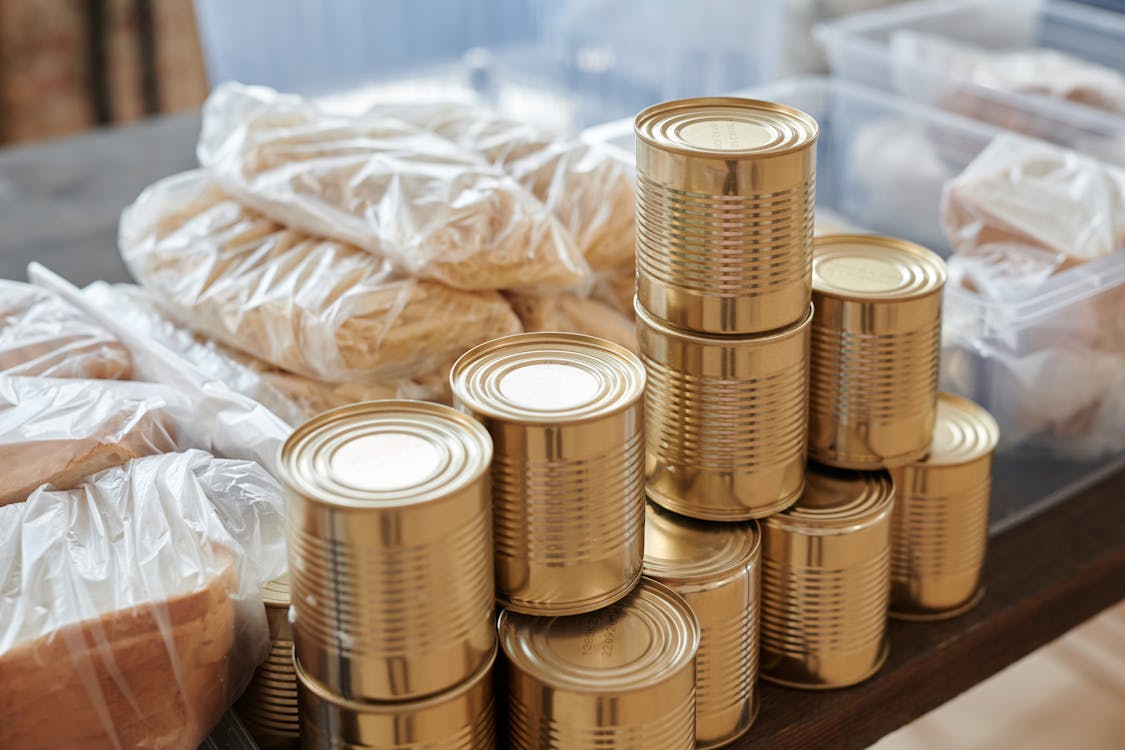
Canned goods rotation. Our pantry holds around 500 cans, rotated regularly with soups, tomatoes, corn, green beans, tuna, salmon, and chicken. These are staples in our diet. Whenever cans go on sale, I pick up twenty rather than two. The oldest cans move to the front, while new ones go at the back. We never really “use” this supply; we just always have it ready.
Honey never expires — legitimately never. There’s 3,000-year-old honey from Egyptian tombs that is still edible. We stock up on 10 pounds of it for its uses as a sweetener, wound treatment, trade item, and comfort food. The 48-ounce raw honey from Nature Nate’s costs around $20, which I buy three times a year.
Salt, sugar, baking soda, baking powder. The forgotten cornerstones. You can’t cook without salt. You can’t bake without baking soda. We keep 20 pounds of iodized salt, 25 pounds of sugar (sealed in mylar), and a years’ worth of leavening agents.
Cooking oils — olive oil, coconut oil, vegetable shortening — make everything more calorie-dense and more palatable. Stored in a cool dark place, they last 1-3 years depending on type. Rotate them like anything else.
Coffee and tea. For my sanity, specifically. I put this in the same category as morale. If Jake has to go without coffee for three months during a grid-down scenario, I have a bigger problem than food storage.
The Container System (Where People Go Wrong)
Most people’s food storage fails not because of what they bought but because of how they stored it. The four enemies of long-term storage are moisture, oxygen, light, and temperature.
Here’s what actually works:
5-gallon food-grade buckets with gamma lids. The gamma seal lids run about $8 each and turn any standard bucket into a spin-off lid system. So much better than the standard lids you need a rubber mallet to remove. I have 30 of these. Most things that are in use daily go in buckets.
Mylar bags + oxygen absorbers. For true long-term storage — rice, wheat, oats, beans that you’re not rotating through — mylar bags are the answer. A 5-gallon mylar bag inside a bucket, filled with dry food, a 2,000cc oxygen absorber dropped in, sealed with a hair straightener. That’s it. That food will outlast your mortgage.
Get the Wallaby 5-gallon mylar bags — about $30 for a pack of 10 — and the 2000cc oxygen absorbers, about $15 for 50.
Mason jars handle everything smaller — spices, salt, sugar in daily use, coffee, tea, baking supplies. Wide-mouth quart jars are my favorite. You can vacuum seal them with the FoodSaver jar attachment ($20) to remove oxygen and extend shelf life dramatically. My spice collection, which I use daily, still has a shelf life of 2-3 years in sealed jars.
One thing I did that I’d recommend to everyone: I labeled every single container with the date I packed it, what’s inside, and the quantity. Sounds obvious. I skipped this step the first time and spent forty minutes trying to figure out which white powder was flour and which was sugar. Not a mistake I made twice.
Temperature Cuts Shelf Life More Than Anything Else
Every 10°F increase in storage temperature roughly halves your food’s shelf life. A cool basement at 55°F stores food about eight times longer than a hot garage at 95°F. If you’re in a hot climate, temperature control for your storage area — even a small window AC unit — is worth serious consideration. Heat is the enemy that most food storage guides underemphasize.
Pro Tip: Temperature matters more than most people realize. Every 10°F increase in storage temperature roughly cuts your shelf life in half. A cool basement at 55°F stores food about 8x longer than a warm garage at 95°F. If you’re in a hot climate, climate-controlled storage is worth serious thought — even a small window AC unit keeping a storage room at 70°F makes a huge difference.
What to Buy First, Second, and Third
The mistake people make is trying to build everything at once. You don’t. You build in layers.
First 90 days: get to one month
This is all about foundation. In your first three months of building:
- Buy 50 pounds of white rice (splits between two sealed buckets)
- Buy 25 pounds of dried beans
- Buy 25 pounds of rolled oats
- Start your canned goods rotation — just buy double of what you normally eat, every time you shop
- Add basics: 5 pounds each of salt, sugar, baking soda
Total cost for a family of four: around $150.
Months 4-9: expand to six months
Once you’ve got one month covered, doubling isn’t twice the work. You’re just refilling a system that’s working. This phase is also where you start adding variety and nutrition:
- Freeze-dried vegetables (we keep Mountain House veggie cases on rotation)
- Canned meats (tuna, chicken, salmon, sardines)
- Cooking oils — buy a case when they’re on sale
- Honey, sugar, coffee, tea in bulk
- Vitamins — important for long-term storage eating
- Baking supplies: yeast, flour, baking powder
Expect to spend $300-400 more across these six months.
Months 10-18: close the gaps to one year
This is where you fill the protein gaps (more beans, add freeze-dried meats if budget allows), get serious about water (a year supply needs to account for cooking water, not just drinking water), and think about comfort and morale.
Also in this phase: equipment. A good manual can opener (we have three, because they always disappear during actual emergencies). A cast iron skillet. A propane camp stove with a six-month supply of canisters. A rocket stove made from cinder blocks in the backyard for extended fuel-free cooking.
Common Mistakes (And I Made Most of Them)
Buying what you don’t eat. This seems so obvious and yet. I have a #10 can of TVP — textured vegetable protein — in my storage from 2020. My kids refuse it. Jake will eat it if it’s disguised as something else. I bought six cans because they were cheap. Six cans of a food nobody in my house wants to eat is worthless storage. Only store what your family will actually consume.
Ignoring calorie density is another one that bites people. A lot of storage guides focus on food items without doing the math on how much energy those foods actually provide. Vegetables are great but they’re mostly water and fiber. Your long-term storage needs enough calorie-dense food to sustain people doing physical work — because grid-down scenarios often involve more physical work than normal life. Rice, oats, fats, and legumes are the calorie foundation for good reason.
Storage that’s never touched becomes a collection, not a food supply. Build your system so what you eat comes from your storage and what you buy goes in the back. The FIFO rule — first in, first out — keeps everything fresh and means you’re genuinely eating food you know tastes good.
Don't Forget Cooking Fuel in Your Food Storage Plan
You can have six months of food and still be unable to eat it if you have no way to cook. Dried rice takes 20 minutes of simmering. Dried beans need an hour or more. Calculate your fuel needs alongside your food — one propane canister handles roughly 8-10 meals. For a year supply, a stockpile of propane plus a rocket stove or outdoor fire setup is essential backup.
Forgetting cooking fuel. You have all this food and then the power’s out and you have no way to cook the rice. We keep a propane camp stove with 12 one-pound canisters, a one-pound propane to 1-lb adapter, and a Dutch oven that works over open fire. Figure out how you’re going to cook before you need to cook.
Skipping the water math. Cooking dry rice takes 2 cups of water per cup of rice. Beans need to soak and then cook. Oatmeal needs water. A year’s supply of food also implies a year’s supply of cooking water, which is different from drinking water. Most storage guides just… forget this. Don’t forget this.
What I’d Do Differently
Honest answer: I’d start the mylar packaging earlier. The first year of my storage, a lot of food was just in its original packaging in bins. Pantry moths got into an 8-pound bag of oat flour. The whole bin was compromised. Everything into sealed mylar now.
I’d also have gotten the grain mill sooner. For the first two years, I was buying flour and storing it. Flour goes rancid in 12-18 months even in sealed storage. Wheat berries in mylar go 25+ years. Buying the mill felt like a big expense — it was $260 — but I use it weekly and it means I’m storing the most shelf-stable form of grain possible.
And I’d have started the canned goods rotation day one, before anything else. It requires zero special equipment, it builds your supply on food you already eat, and it’s essentially free (you’re just buying what you’d buy anyway, but more of it, on sale). Two years of good rotation buying puts a lot of cans in your basement without you feeling it in the budget.
For the bigger picture on where food storage fits into a complete emergency plan, our complete emergency preparedness guide lays out the whole system. Food is one layer of it — and usually the most approachable place to start.
If you want to go deeper on what specific brands of freeze-dried food are worth the money (and which aren’t), I wrote a comparison of the best freeze-dried food brands after we tested several of them over the last two years.
Questions about food storage? The comments section below is the best place — the Survivorpedia community has some seriously experienced canners and long-term storage folks who are generous with their knowledge.