This article contains affiliate links. We may earn a small commission if you purchase through these links, at no extra cost to you.
Hurricane Irma, September 2017. I had three boys under nine years old, a wife at work two hours north, a dog with a torn ACL in a cone of shame, and a mandatory evacuation order for our county.
I had no plan. None. I stood in the kitchen with a notepad for forty minutes trying to figure out where we were even going. North to my parents? East to my brother’s? Stay in a shelter? Take 75 or 27 or the back roads that would add two hours but avoid traffic? I didn’t know.
We ended up in a Days Inn in Ocala with two adults, three boys, one semi-mobile dog, and a single bag of clothes I’d packed in twenty minutes. We made it fine. But “made it fine” is not a plan. “Made it fine” is luck.
The next month, I made an actual plan. It took about four hours total — split across three evenings — and I’ve revised it twice since then. Now, every person in this family (including the eight-year-old, with modifications) knows what to do if something goes wrong.
Here’s exactly how we built it.
Start With the Conversations You’re Avoiding
Most families don’t have an emergency plan because the conversation feels awkward. We don’t want to alarm the kids. We don’t want to admit that bad things could actually happen. So we keep meaning to “do that one day.”
Do it now. This week. It genuinely doesn’t take as long as you think, and the fear is almost always worse than the actual conversation.
For us, it started with a Sunday dinner conversation that began: “We’re going to talk about what our family does if there’s ever an emergency. Not because anything bad is going to happen, but because knowing the plan is like knowing where the fire extinguisher is — you hope you never need it but you feel better knowing.”
The boys were ten, eight, and five at the time. The ten-year-old asked reasonable questions. The eight-year-old asked if we were going to have to fight anyone (we are not). The five-year-old announced that he would protect the family from tornadoes using his superhero cape and then asked for more macaroni.
The complete guide to emergency preparedness covers a lot of what goes into a family prep system — the evacuation plan is one critical piece of it. Don’t skip this part because you have food and water sorted. The plan is what makes all of it usable.
Define Your Threat Scenarios First
An evacuation plan needs to account for your actual threats. Ours in Central Florida:
- Hurricanes (our most likely)
- Wildfire (we’re near scrub areas)
- Chemical plant incident (there’s a facility six miles east)
- Extended power outage (not technically an evacuation but sometimes we leave)
Your threats look different in Montana (wildfire, blizzard, earthquake), in Kansas (tornado, flood), in California (wildfire, earthquake), or in the Pacific Northwest (volcano, earthquake, tsunami if you’re coastal). Spend twenty minutes listing what’s actually plausible in your area before you build the plan.
Why does this matter? Because “bug out north” is a great idea if the threat is a hurricane approaching from the south, but a terrible idea if there’s a wildfire burning north of you. And “shelter in place” works for a chemical spill downwind from you but is wrong if the spill is upwind.
The threat analysis doesn’t need to be complicated. Just: “What are the most likely emergencies here, and for each one, does it require us to leave or stay?” Write this down. It’s the foundation everything else builds on.
Your Evacuation Direction Depends on the Threat
Bug out north is only smart if the threat is coming from the south. Before you finalize any evacuation routes, map your specific threats against cardinal directions — a wildfire approaching from the north requires you to go south, not north. Your plan should explicitly state which direction to go for each type of emergency your area actually faces.
Establish Your Rally Points
If your family is scattered when something happens — which is usually the case, because emergencies are inconsiderate like that — everyone needs to know where to meet.
We have two rally points, and every person in the family knows both.
Rally Point 1: Close to home. Our neighbor Diane’s house, two doors down. She’s a retired nurse, she’s always home, she knows we use her address for this purpose. If something happens while we’re all near home and we need to get out of our house — fire, gas leak, whatever — we go to Diane’s front porch and wait.
Rally Point 2: About two miles from home. The parking lot of a specific grocery store on the main road out of our neighborhood. If we need to evacuate and some family members are driving from different locations, we can meet here before we get on the highway. The store is far enough from our neighborhood to be away from a local incident but close enough to not require a lot of driving.
The rally points should be:
- Locations everyone can reliably find, even if phones aren’t working
- Not on a route that’s likely to be blocked or dangerous
- Easy to identify in poor conditions (smoke, rain, night)
We also have an out-of-state contact — my sister in Tennessee. She’s not local to any of our Florida threats and she has a stable address and phone. If local lines are jammed (this happened after Irma — cell service was genuinely terrible for two days) or if we’re separated, everyone in our family has the Tennessee number memorized or written down. You contact her. She becomes the information hub. She tells each person where everyone else is.
This is actually FEMA guidance and it works. Get an out-of-state contact. Give the number to your kids in a form they can access without a phone.
The Communication Protocol
When phones work: my wife and I text first (it often goes through when calls don’t), then call.
When cell lines are jammed: text still often works when voice calls don’t. Texts queue and deliver when there’s bandwidth. We have a family group text and a rule that everyone sends a status update the moment something happens: “I’m at school, I’m fine.” “I’m at work, leaving now.” “I’m home.”
When there’s no cell service: designated rally points and a check-in time. If I can’t reach my wife and I’m evacuating, I go to Rally Point 2, wait one hour, then proceed to our primary evacuation destination and leave a note on the physical mailbox at Rally Point 2 with our destination (we agreed on this in advance).
Leave a Physical Note When You Move to a New Location
If you’re evacuating and someone may be looking for you at a rally point, leave a written note with your destination and departure time taped to the agreed landmark — a mailbox post, store entrance, or specific sign. In a no-cell scenario, this note is how the rest of your family tracks your movement. Agree on the note placement in advance so everyone checks the same spot.
For two-way communication when cell networks are down, we have a pair of Motorola Talkabout T800 FRS radios — about $50 for the pair. Range is maybe 1-2 miles realistically in suburban conditions. They’re for short-distance coordination when we’re nearby but separated.
For longer range when we really need it, our emergency radios cover NOAA weather broadcasts and allow monitoring of what’s happening in the area.
Your Primary and Secondary Evacuation Destinations
During Irma prep, I stood in the kitchen for forty minutes because I had no destination decided. This is the thing to fix first because everything else depends on it.
Primary destination: Where are you actually going? Family? Friends in a less-affected area? A specific hotel chain that allows pets in a city 150-200 miles away? This should be decided, written down, and have an actual address you can navigate to even without phone service.
Our primary is my brother’s place north of Gainesville — about 2.5 hours in normal traffic. I have the address memorized. It’s written on a card in our go-bags. Our boys know it. We’ve driven the route.
Secondary destination: If your primary isn’t available — the roads are blocked, your family’s place is affected too, the hotel is full — where then? Our secondary is my parents in North Carolina. Eleven hours. Not ideal. But it’s a plan.
Tertiary: We know which shelter in Gainesville takes pets. We’ve never used it, but we know where it is and what documentation the dogs need to get in.
Work through this for your family. It might be a parent’s house, a friend in another region, a hotel chain you know takes pets. Write it down. Make sure it’s not stored only in your phone.
What Goes in the Go-Bags
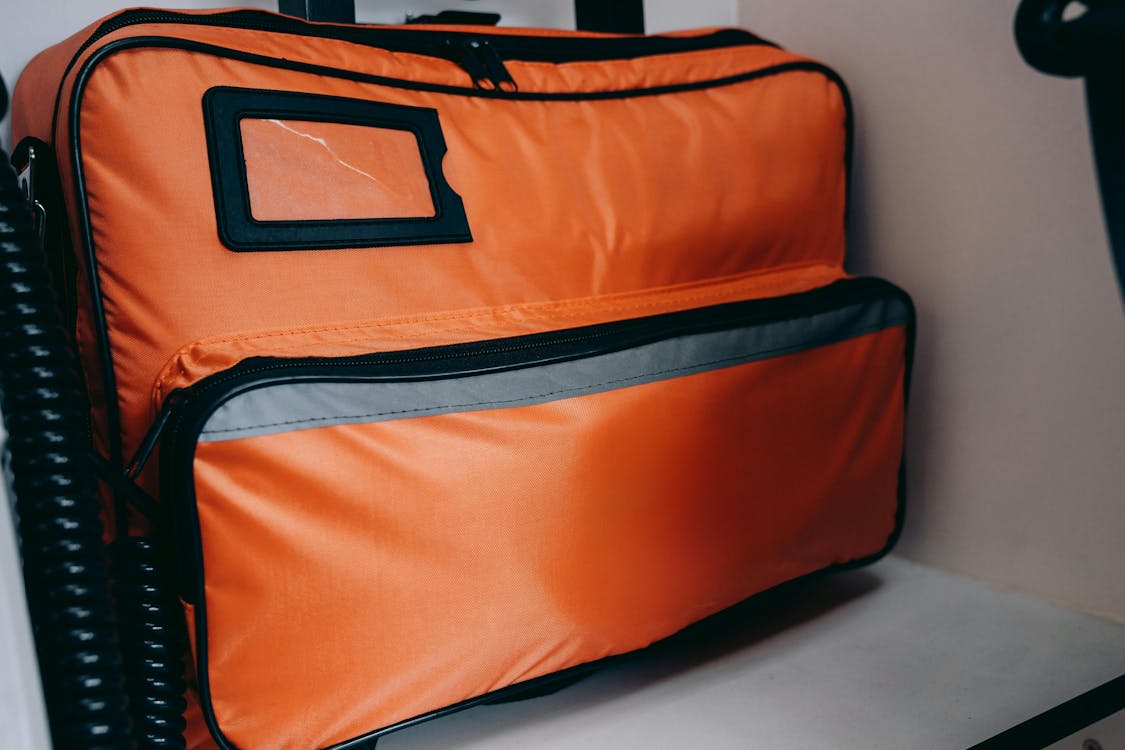
Every person in our family has a bag. Mine is a proper backpack. My wife’s is a large duffel. The boys each have a small school-backpack sized bag. The dog has a separate tote.
The point of a go-bag is that when we need to leave in under thirty minutes — which is often the window in a mandatory evacuation — we don’t stand in the bedroom trying to remember what to pack. We grab the bags. They’re ready.
Here’s what’s in each:
Adult bags (one bag handles adult needs, we split it):
- 3 days of clothing (minimal — jeans, t-shirts, one warm layer)
- Prescription medications, 30-day supply minimum (we maintain this supply separately)
- All our important documents in a waterproof folder: IDs, passports, insurance cards, car titles, house deed, medical records for each family member
- Cash — $500 in small bills ($20s and smaller)
- Phone chargers and a battery bank
- Basic first aid kit — the Adventure Medical Kits Ultralight/Watertight .7 ($30)
- A few days of non-perishable snacks
Kids’ bags (they pack themselves with supervision):
- 3 days of clothes
- One comfort item each (the rule is it has to fit in the bag)
- A small flashlight
- Their own water bottle
- Snacks they like
Dog bag:
- Five days of dog food in a zip-lock
- Water bowl
- Vet records including vaccination records (shelters require these)
- A spare leash and collar
- Flea/heartworm/medication
Most Emergency Shelters Do Not Accept Pets
If your evacuation plan relies on shelters as a fallback, research your specific county’s pet policies before an emergency. The majority of public emergency shelters do not accept animals. Identify pet-friendly shelter locations, pet-friendly hotels along your route, or a friend/family destination that accepts your animals — before you need this information.
The bags live in the same closet. We go through them twice a year — September (hurricane season) and March — to replace expired snacks, update clothing sizes (kids grow fast), check batteries.
Pro Tip: Scan all your important documents and store them in a cloud drive that every adult family member can access. Your birth certificates and insurance cards should not be accessible only on one person’s phone. When my phone died during a post-hurricane insurance claim, I needed my wife to look up the policy number from her account.
Evacuation Route Planning
We have three mapped routes out of our area. All different. One uses only highways. One uses only back roads. One mixes both and avoids the biggest bottleneck that forms on I-4 during major evacuations.
I’ve driven all three. Not during an emergency — just on random weekend afternoons to know them. There’s a bridge on the back-road route that I didn’t know had a weight limit. Found that out because I drove it. Not relevant for a passenger car, but we have a truck that sometimes hauls heavy loads and I wanted to know.
We also have:
- A current road atlas (paper, not just phone — phones die)
- The non-default roads entered as favorites in both our phones for offline access
- The evacuation zone map for our county printed and laminated, living in the car
Know your evacuation zone if your area uses them. Zone A is usually coastal and the most urgent. Zone D might not need to go at all during most storms. We’re Zone C, which means we evacuate for Cat 3+ storms hitting our coast. This matters because leaving too early clogs roads for people who actually needed to go first, and leaving too late traps you.
Talking to Kids About the Plan
The goal is not to terrify them. The goal is to give them information that makes them feel more in control, not less.
We frame it as: “Our family knows what to do. We have a plan. You know the plan. So if something ever happens, you’ll know exactly what to do and where we’ll find you.”
Kids, especially school-age kids, want to feel capable. Give them a job. Our ten-year-old is responsible for the go-bag check twice a year — he goes through it and makes a list of what’s expired or needs replacing. He takes this seriously. The eight-year-old is responsible for filling the water bottles in the bags before we leave. The five-year-old carries his own bag.
We practice the rally point — casually, maybe once a year. “Hey, let’s go to Diane’s, just so you remember how to get there.” We don’t make it feel like a drill. It’s just a visit to Diane, who gives them cookies and asks about school.
One conversation I’d recommend having explicitly: what to do if something happens at school. Where do you go? Who picks you up? What if the person who’s supposed to pick you up can’t get there? Our kids know this. They know to go to the school shelter, give their name to the staff, and wait. They know that someone will come.
The Family Emergency Plan Card
After we built all of this, I made a laminated card for each person in the family. It fits in a wallet or backpack pocket. Ours has:
- Rally Point 1 address
- Rally Point 2 address and landmark description
- Jake’s cell, my cell, each other’s work numbers
- Out-of-state contact name and number (Jake’s sister)
- Primary evacuation destination address
- Secondary evacuation destination address and contact number
- Nearest shelter address that takes pets
The boys’ cards also have their teacher’s name and our neighbor’s name and number.
I paid $3 to laminate them at the UPS Store. They’ve survived two go-bag reorganizations and a washing machine incident. Lamination was a good call.
For the document side of things, our vehicle emergency kit covers what lives in the car year-round — some of that overlaps with evacuation supplies and it’s worth making sure your car kit is updated when you update your go-bags.
One Final Thing
A plan is only as good as the last time you checked it. Our family has changed since 2017 — we have another kid, our dogs have changed, our primary destination changed when Jake’s brother moved, we now have an older kid who should be more involved in the plan.
Set a recurring calendar reminder — I do mine September 1 for hurricane season — to review and update the plan. It takes maybe an hour if you do it every year. The things that change are usually small. But a plan with an old address or a disconnected phone number is a plan that won’t work when you need it.
Make the plan. Write it down. Tell every family member. And then go have dinner and stop thinking about it. The whole point is that when something happens, you don’t have to think — you just execute the plan you already made.
Have you tested your evacuation plan? The best way to find the gaps is to actually try to follow it — even just a walk-through at home with the family. It always reveals something.