This article contains affiliate links. We may earn a small commission if you purchase through these links, at no extra cost to you.
Warning: Never eat any wild mushroom unless you are 100% certain of its identification. Many edible species have toxic lookalikes. Always cross-reference multiple field guides and, when possible, consult an experienced local forager before consuming anything wild.
The first wild mushroom I ever ate with full confidence was a chanterelle. Summer 2011, the Cascade Range in Washington. My buddy Holt had been foraging mushrooms for 20 years and he walked me through the identification so methodically I felt like I was back in school. Color. Gills — or in chanterelles’ case, the lack of true gills. Smell. Habitat. False gills versus true gills. Lookalike comparison.
We sat on a log for probably 40 minutes over one mushroom before he’d let me put it in the basket.
That’s the right pace. And that’s the perspective I’m writing from. I’m not a mycologist. I’m a guy who spent years learning cautiously under guidance before I foraged solo. The five mushrooms in this article are the ones I teach beginners because they have reliable identifying features and limited dangerous lookalikes. They are not the only safe mushrooms. They’re just where I’d start.
Table of Contents
- The One Rule You Can’t Skip
- Chanterelles
- Chicken of the Woods
- Giant Puffballs
- Oyster Mushrooms
- Morels
- What You Need Before You Start
- Common Beginner Mistakes
The One Rule You Can’t Skip
Learn from a person, not just a book.
Books are essential. But field guides have photos taken in ideal lighting by photographers who chose photogenic specimens. The mushroom in front of you is dirty, maybe misshapen, maybe slightly past peak, maybe in different light. A field guide can’t interact with you.
Find a local mycological society. Most regions have them and most do free or cheap foray walks. The North American Mycological Association (NAMA) maintains a directory at namyco.org. Spend a single afternoon with an experienced forager and you’ll learn more than three months of book study.
Then keep learning. The goal is to get to a point where you can identify a mushroom with multiple confirming characteristics — not just “it looks right” but “it has the right color, AND the false gills, AND the fruity smell, AND the right habitat, AND it matches three guides.” That convergence of evidence is what safety looks like.
The edible wild plants beginner’s guide covers the same layered-confirmation approach for plants. Same logic applies here.
Chanterelles
Cantharellus cibarius. Bright golden-yellow, trumpet-shaped, found in moist coniferous or mixed forests. One of the best-tasting wild mushrooms in North America. Also one of the best for beginners because its features are distinctive.
Key identifying features:
The most important: chanterelles have false gills. Not true plate-like gills that separate cleanly from the cap — they have forking ridges that are blunt-edged and run down the stem. Run your finger along them. True gills snap off. False gills don’t; they feel more like the ridges of a cantaloupe skin.
Cap is golden to egg-yolk yellow. Irregular, wavy-edged, vase-shaped as it matures. White flesh inside. Fruity, apricot-like smell — genuinely distinctive once you know it.
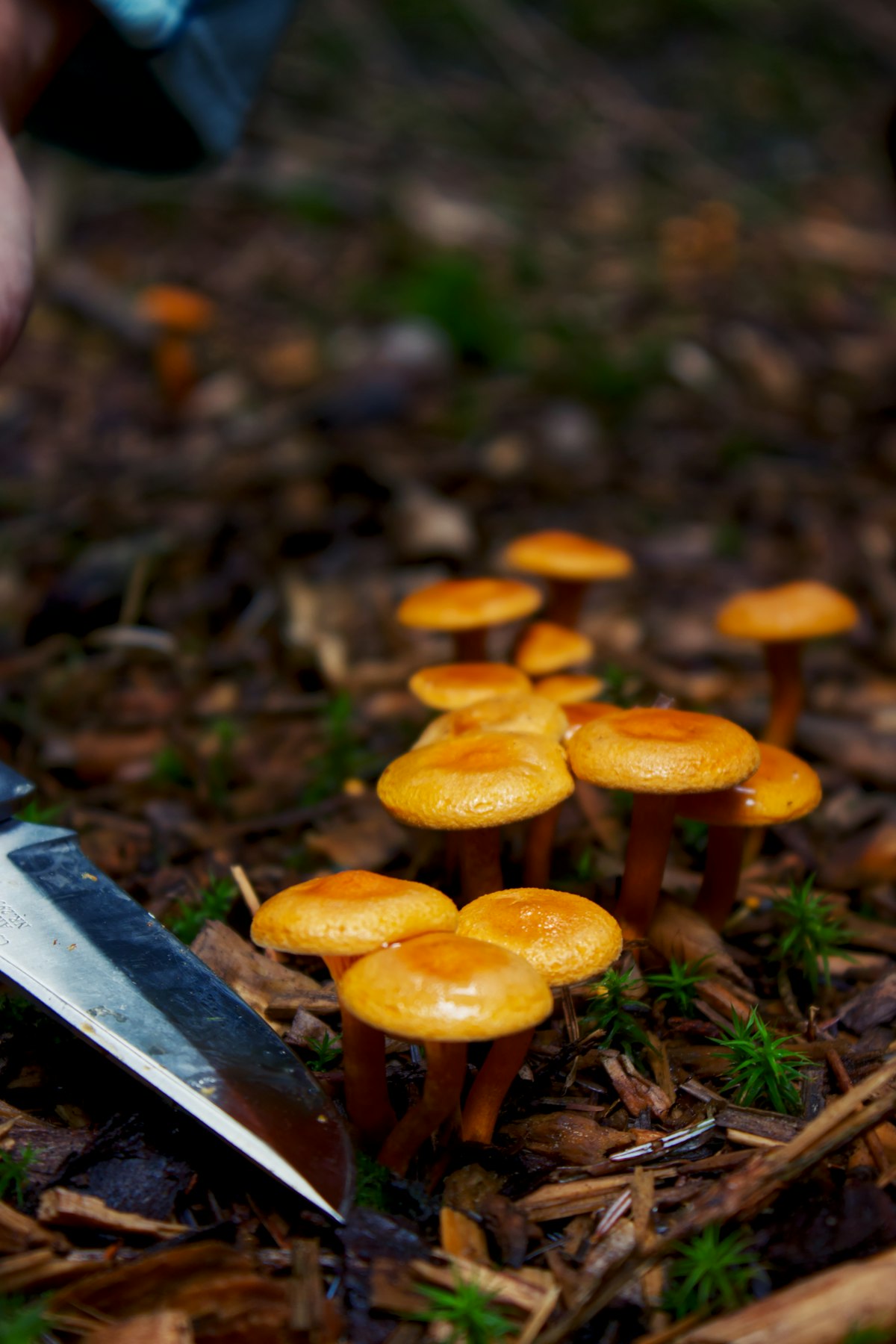
The lookalike concern: Jack-o’-lantern mushrooms (Omphalotus species) are the main one to know. They’re orange rather than golden, grow in clusters at or near wood, and have true sharp gills. Make sure your chanterelle is growing from soil, not wood, and check those false gills.
I bring a field guide specific to my region every single time. Not because I’m unsure of chanterelles at this point. Because habit and consistency are how mistakes get prevented.
Jack-o'-Lantern Mushrooms Are the Chanterelle's Dangerous Lookalike
Jack-o’-lanterns (Omphalotus species) cause severe gastrointestinal illness and are sometimes confused with chanterelles. The key distinction: chanterelles grow from soil and have false, forking ridges — jack-o’-lanterns grow from wood in clusters and have sharp, true gills. When in doubt, check the base of the stem. If it’s growing from wood, it’s not a chanterelle.
Chicken of the Woods
Laetiporus sulphureus / Laetiporus cincinnatus. Big shelf fungus. Sulfur-yellow to orange in color, overlapping brackets growing from wood. Named for its texture and taste — it genuinely does taste somewhat like chicken. My boys think I’m lying when I say that. I’m not.
Key identifying features:
Size alone makes this among the easiest mushrooms to identify. Young specimens are vivid bright orange on top, sulfur-yellow below. The underside has tiny pores — not gills, pores. Tiny hexagonal tubes. No gills whatsoever.
Grows from living or dead hardwood trees. Sometimes from the base of conifers in the West, though the western subspecies can occasionally cause reactions in some people (rare but documented — worth knowing).
The safety note: Some people have adverse reactions to chicken of the woods, particularly when it’s growing on certain host trees. Eat a small amount the first time. Not a pound of it. Small sample, wait 24 hours. This is good practice with any new wild food regardless of species.
No dangerous lookalikes in most of its range. The combination of shelf growth, bright sulfur color, and pore surface is distinctive enough that I’m comfortable recommending this as a beginner species. If you see a big orange-yellow shelf fungus on a hardwood tree, you’re almost certainly looking at chicken of the woods.
Harvest when young and bright. Old specimens get dry, bitter, and tough.
Giant Puffballs
Calvatia gigantea. Hard to mistake a volleyball-sized white sphere growing in a field for anything dangerous — and that’s basically what a giant puffball is. White throughout, smooth surface, no gills, no cap, no stem as a mature puffball. Just a white ball.
The critical safety check: Cut it in half. Inside must be pure white and uniform throughout. No internal structure, no gills, no hint of a mushroom taking shape inside. This rules out the dangerous Amanita species, which can begin life as white eggs that look superficially like small puffballs. A young death cap (Amanita phalloides) sliced open will show a nascent cap, gills, and stem inside even as a small button-stage mushroom. Pure white = safe. Anything else inside = do not eat.
Always Cut Puffballs in Half Before Eating
The single safety check that separates a safe puffball from a deadly Amanita egg: cut it completely in half from top to bottom. A safe puffball is pure white and uniform inside — no cap, no gills, no structure of any kind. Any hint of an internal mushroom forming means you may have a death cap in the button stage. Never skip this check, even with specimens that look perfectly round from the outside.
Puffballs that have started to yellow inside are past peak but not dangerous. They just taste like dirt at that point, so there’s no reason to eat them.
Slice and sauté in butter. Giant puffballs have a delicate flavor that absorbs seasoning well. A large one can feed a family. I found one the size of a basketball in a sheep pasture in central Oregon around 2016 — I made enough food for dinner for six people.
Oyster Mushrooms
Pleurotus ostreatus. Shelf-growing. Fan-shaped cap, white to gray-brown to tan, with white gills that run down the stem. Grows in clusters from dead hardwood. Year-round in milder climates, fall and spring in colder regions.
Key identifying features:
White gills. White spore print (let a cap sit on dark paper for a few hours). Mild anise or sweet smell. Cap attached at the side to the stem, not center-mounted. Usually growing from dead or dying wood in overlapping clusters.
The lookalike concern: Angel wings (Pleurocybella porrigens) look somewhat similar — small, white, fan-shaped — but grow on conifer wood, are much smaller, and are thinner and more fragile. There have been documented deaths from angel wings in Japan, though the mechanism isn’t fully understood. The practical rule: oyster mushrooms on hardwood are consistently safer than anything that resembles them on conifers. Stick to hardwood if you’re new to this.
Pro Tip: Oyster mushrooms often grow high on standing dead trees as well as fallen logs. Check eye level on dead elms and aspens, not just the ground. Some of my best oyster mushroom finds have been on logs I almost walked past because I was scanning the ground.
Morels
Last and honestly my favorite. Morchella species. Hollow, honeycombed cap that looks like nothing else in nature. Black, gray, yellow — depending on species and age — but always that unmistakable pitted surface covering both cap and stem.
Spring mushrooms. They follow lilacs and apple blossoms in most of the Midwest and East. Finding a good morel spot is worth keeping secret. I’m not joking — my brother-in-law stopped telling people where his spots were after he showed up in May and found obvious signs of someone else having been there first.
Key safety check: Cut it in half lengthwise. Morels are entirely hollow from stem base to cap tip. No internal chambers, no solid core. Hollow.
The lookalike concern: False morels (Gyromitra species) are the thing to know. They look similar but are saddle-shaped and wrinkled rather than pitted, and are not fully hollow — they have cottony folds inside. They’re toxic. The comparison in a good field guide is pretty clear, but if you’re new, this is exactly the species to review with an experienced forager before you’re comfortable.
Split Every Morel Before You Eat It
The morel’s single definitive safety check is also its most important: cut the mushroom lengthwise and confirm it is completely hollow from the stem base all the way to the cap tip. False morels (Gyromitra species) are toxic and have cottony or chambered interiors. A true morel has nothing inside — just air. This takes five seconds and is non-negotiable.
Dry-sauté morels briefly before adding butter. They release moisture first; let that cook off. Then butter and salt. I’ve never had a morel preparation that was complicated that wasn’t worse than a simple butter-and-salt version.
What You Need Before You Start
A few things beyond identification knowledge:
Field guides for your specific region. National Audubon Society and Peterson guides are solid. My preference is the “All That the Rain Promises and More” by David Arora for the West — it’s conversational, detailed, and genuinely fun to read. David Arora’s “Mushrooms Demystified” is the comprehensive reference if you want to go deep.
A mesh bag for collecting. Not a plastic bag. Mesh allows spores to continue distributing as you walk, which is good for the ecosystem and for your future foraging spots. A simple canvas tote works. I use a foldable wire mesh basket.
A knife for clean cuts. Some foragers twist-and-pull, some cut. I cut at the base to leave the mycelium undisturbed. Matters more for some species than others, but it’s a good habit.
A reliable spore print process. Take caps home, place gill-side down on a piece of white or dark paper (use dark for white-spored species, white for dark-spored), cover with a bowl, wait several hours. The print color is a critical confirming identifier for many species.
Common Beginner Mistakes
Mistake 1: Eating without 100% ID confirmation. This is how people die. Not hyperbole. The death cap (Amanita phalloides) kills people every year in North America, primarily recent immigrants who mistake it for species they recognized from their home countries. Certainty, not probability. If you’re 90% sure, don’t eat it.
Mistake 2: Relying on a single field guide. Cross-reference at least two guides, ideally three. If the descriptions don’t match, dig deeper before eating. Inconsistency between guides often means you’re looking at a variable species or a lookalike.
Mistake 3: Ignoring habitat. Where a mushroom is growing tells you as much as what it looks like. The wrong species on the wrong tree, in the wrong season, in the wrong region — that should trigger a full re-identification. Habitat is a character, not a footnote.
Mistake 4: Picking old specimens. Old mushrooms are harder to identify — the distinctive colors fade, the textures change, the smells become generic “mushroomy” instead of species-specific. When I can’t make a confident ID on a specimen, I leave it and find a fresher one from the same patch.
Mistake 5: Not eating a small test amount first. Even correctly identified edible mushrooms can cause reactions in sensitive individuals, and a few species have known reaction patterns at first consumption. Eat a small amount. Wait. I do this with every new species I eat for the first time, even species I’m fully confident identifying. It’s just sensible.
Start with one species. Learn it completely — not just “looks right” but the full suite of confirming characteristics. When you can identify it confidently in multiple conditions, add a second species. Slow and boring compared to just eating things, sure. But you only have to be wrong once.
Take our wilderness survival basics quiz if you want to test your broader foraging and wild food knowledge.
This article contains affiliate links. We only recommend products we’ve personally tested. See our affiliate disclosure.