This article contains affiliate links. If you buy something through these links, we may earn a small commission at no extra cost to you. We only recommend gear we’ve actually used and would buy again.
There’s a guy I know — I’ll call him Marcus because that’s his name — who spent $2,800 on a rifle before he ever killed a deer. Custom stock, match barrel, premium glass, the works. Looked like something a sniper would leave behind. He’d been to the range twice with it when opening day rolled around.
First Saturday of bow season the following year, he killed a doe with a $220 crossbow he bought at Cabela’s on clearance.
Here’s the thing: Marcus is not a bad hunter. He got caught in the same trap that catches roughly half the hunters I’ve ever taken to a gun shop — the belief that the rifle is where the hunt gets won or lost. Buy enough gun and the rest handles itself.
It doesn’t work that way. Never has.
I’ve been hunting since I was nine years old, mostly deer and hogs in the South before I started going after elk out west in my thirties. My grandfather was career military, my dad retired from the Army at twenty years, and I grew up handling rifles the way some kids grew up handling baseball bats. I’ve carried cheap rifles, expensive rifles, borrowed rifles, issued rifles. And after all of it — 25-plus years, a lot of different states, a lot of different game — my conclusions are probably not what you’d expect from someone who writes about this stuff.
You don’t need the best rifle. You need the right rifle. And those are very different things.
This guide is going to walk you through every decision you actually need to make: caliber by game animal, action type, barrel length, stock fit, budget, and specific rifles worth buying. We’re going to cover the comparison table most guides avoid because it makes things feel too simple. We’re going to talk about optics because a great rifle with garbage glass is a liability.
By the end, you’ll know exactly what to buy and why.
Start With the Game Animal, Not the Gun
Most guys walk into a gun shop thinking about what they want to shoot. They should be thinking about what they’re hunting.
The rifle question is really a caliber question first. Everything else — action, barrel, stock — matters less than having the right cartridge for the job. A .243 Winchester is a perfect deer rifle. It is completely inadequate for elk. A .375 H&H will kill anything on the North American continent but it’s overkill for squirrels and punishes the hell out of you at the bench.
Match the caliber to the animal first. Pick the rifle after.
Here’s the caliber-to-game reference table I’d hand to anyone asking what they should be shooting:
| Caliber | Primary Game | Effective Range | Recoil | Ammo Cost |
|---|---|---|---|---|
| .22 LR | Varmints, small game | 100 yards | Minimal | $0.07–0.12/rd |
| .223 / 5.56 NATO | Varmints, coyotes, small hogs | 300 yards | Low | $0.35–0.60/rd |
| .243 Winchester | Deer, varmints (dual-purpose) | 300 yards | Low | $0.80–1.20/rd |
| 6.5 Creedmoor | Deer, elk, hogs | 600+ yards | Moderate | $1.00–1.60/rd |
| .308 Winchester | Deer, elk, hogs, black bear | 500 yards | Moderate | $0.80–1.30/rd |
| .30-06 Springfield | Deer, elk, hogs, black bear, moose | 500 yards | Moderate-High | $1.00–1.50/rd |
| .300 Winchester Magnum | Elk, moose, long-range deer | 700+ yards | High | $1.80–3.00/rd |
| .338 Winchester Magnum | Brown bear, moose, elk | 500 yards | Very High | $2.50–4.00/rd |
| .45-70 Govt | Brush deer, black bear, hogs | 200 yards | High | $1.20–2.00/rd |
| 7mm Remington Magnum | Elk, mule deer, long-range | 600+ yards | High | $1.50–2.50/rd |
| 6.5 PRC | Elk, mule deer, long-range | 700+ yards | Moderate-High | $1.60–2.50/rd |
Note that “effective range” is for ethical hunting shots — where you can consistently put a bullet in the vital zone — not theoretical ballistic distance. Most hunters should cut those numbers in half for honest field conditions.
Caliber by Game Animal: The Real Breakdown
Whitetail Deer
The truth is, you can kill deer with almost anything. That’s not encouragement to undergun — it’s context. Whitetail deer are not large animals. A mature Midwest buck weighs 150-180 pounds on the hoof, and a lot of the deer I’ve killed in Florida and Georgia weighed under 120. They’re not elk.
For deer, my recommendation is this: shoot the flattest-shooting, lowest-recoil cartridge that still gives you adequate bullet weight and energy at your maximum expected range.
For most Eastern and Midwestern hunters, that’s the 6.5 Creedmoor or .308 Winchester. Both will kill deer cleanly from 50 to 400 yards. The 6.5 kicks less and shoots a little flatter; the .308 has a slight edge in terminal performance at closer ranges and ammo is more universally available.
The .30-06 is what my grandfather shot and what his father shot. Still works. Still kills deer. The ammo has gotten better since the 1950s and the cartridge hasn’t changed.
.243 Winchester if you’re recoil-sensitive or hunting with a younger shooter — plenty of punch for deer inside 300 yards, and a 10-year-old can shoot it without developing a flinch.
Avoid for deer: anything with “Magnum” in the name unless you’re chasing mule deer in open country past 400 yards. The extra recoil teaches flinch, the extra power is wasted at close range, and the ammo costs twice as much.
Elk
Elk are a completely different conversation. A mature bull can weigh 700-900 pounds. They’re built heavy through the shoulders, thick-boned, and they are — there’s no other word for it — tough. I’ve seen marginal shots on elk produce 200-yard runs before the animal bedded down. That’s not a fun recovery.
For elk, minimum is .308 Winchester or .30-06, and even then you want premium bullets — Federal Trophy Bonded, Nosler Partition, Hornady GMX. Not cheap Walmart softpoints.
Better: 6.5 PRC, 7mm Remington Magnum, or .300 Winchester Magnum if you’re doing western hunting where shots regularly extend past 300 yards. These cartridges punch harder and carry more energy at distance.
I killed my first bull elk in Colorado in 2011. I was carrying a Weatherby Vanguard in .300 Win Mag — borrowed from a friend who thought I’d regret showing up with a .308. The shot was 280 yards across a canyon. Clean kill. But I won’t pretend my shoulder wasn’t sore after a week at altitude sighting it in at the range. Magnum calibers earn their reputation on elk. They also earn the bruises.
Black Bear and Hogs
Black bear: treat like elk in terms of caliber requirements. They’re not as large as elk but they’re dense-boned and fat, and a bad shot on a black bear in timber can ruin your week fast.
.308, .30-06, or heavier. Same premium bullet recommendation.
Wild hogs are interesting because the hunting context matters more than the animal’s toughness. Spot-and-stalk on a single hog? A .308 or even .243 handles it fine. Calling in packs at night over bait where you might be taking multiple fast shots? Semi-auto in 5.56 or .308 changes the equation entirely. Hog hunters running AR-platforms for that reason aren’t wrong.
Big boars — 250-pound-plus animals — deserve the same respect as deer caliber-wise. Don’t underestimate them just because they’re considered a nuisance animal.
Varmints and Small Game
Here the caliber conversation flips. You want the smallest effective caliber, both to avoid destroying meat on small animals and because you’ll be shooting more rounds and cost per round matters.
.22 LR for squirrel, rabbit, rats — it’s almost perfectly designed for this.
.17 HMR if you want flat shooting and more range than .22 LR offers. Great for prairie dogs at 150-200 yards.
.223 / 5.56 for coyotes and larger varmints, or small hogs where you want more reach and a faster bullet. The standard AR-15 chambering serves double duty here — the platform works well for multiple shots and the ammo is cheap enough to practice with seriously.
Caliber Is a Starting Point, Not an Endpoint
The caliber debate matters less than bullet selection within a caliber. A .308 loaded with a cheap 150gr softpoint is a worse elk bullet than a .308 loaded with a 180gr Nosler Partition. Know your caliber and know your load — the combination is what kills cleanly, not the number stamped on the box.
Action Types: Bolt, Semi-Auto, Lever
Bolt Action
If you’ve read my other pieces, you know where I land here. Bolt action is the right answer for most hunters most of the time. And I’m not going to apologize for that being a boring answer.
The mechanical argument: bolt actions lock up more solidly than any other design, which contributes to inherent accuracy. A bolt gun that feeds and chambers reliably will do so in -10°F, in mud, after a fall down a hillside. They’re simpler to maintain and diagnose when something goes wrong.
The practical argument: hunting requires one good shot, not many fast shots. The discipline of cycling a bolt between shots makes you a more deliberate hunter. I’ve seen guys with semi-autos spray three rounds at a running deer and hit nothing. I’ve seen a guy with a bolt gun pass on a marginal shot because he knew he’d only get one clean opportunity — and he waited, and he killed the deer clean.
That said. There’s nothing magical about cycling a bolt. If you shoot a semi-auto better, shoot a semi-auto. Just be honest about why you’re making that choice.
Semi-Auto
Semi-autos have a legitimate home in hog hunting, and increasingly in long-range precision work where follow-up shots matter.
AR-10 in .308 is probably the most practical semi-auto hunting platform — takes detachable magazines, spare parts are everywhere, it handles well in close timber. The tradeoff is weight (typically 8-9 lbs unloaded) and bulk.
AR-15 in 5.56 or .300 Blackout for hogs, coyotes, or smaller deer in states where that caliber is legal.
The concern with semi-autos for hunting isn’t reliability — modern semi-autos are quite reliable. It’s the psychological permission to take marginal shots because you can “make it work with a follow-up.” That’s a trap. A bad shot on a deer is a bad shot whether you chamber another round in half a second or half a minute. Make the first one count regardless of what’s in your hands.
Lever Action
I have a soft spot for lever guns. Won’t pretend otherwise.
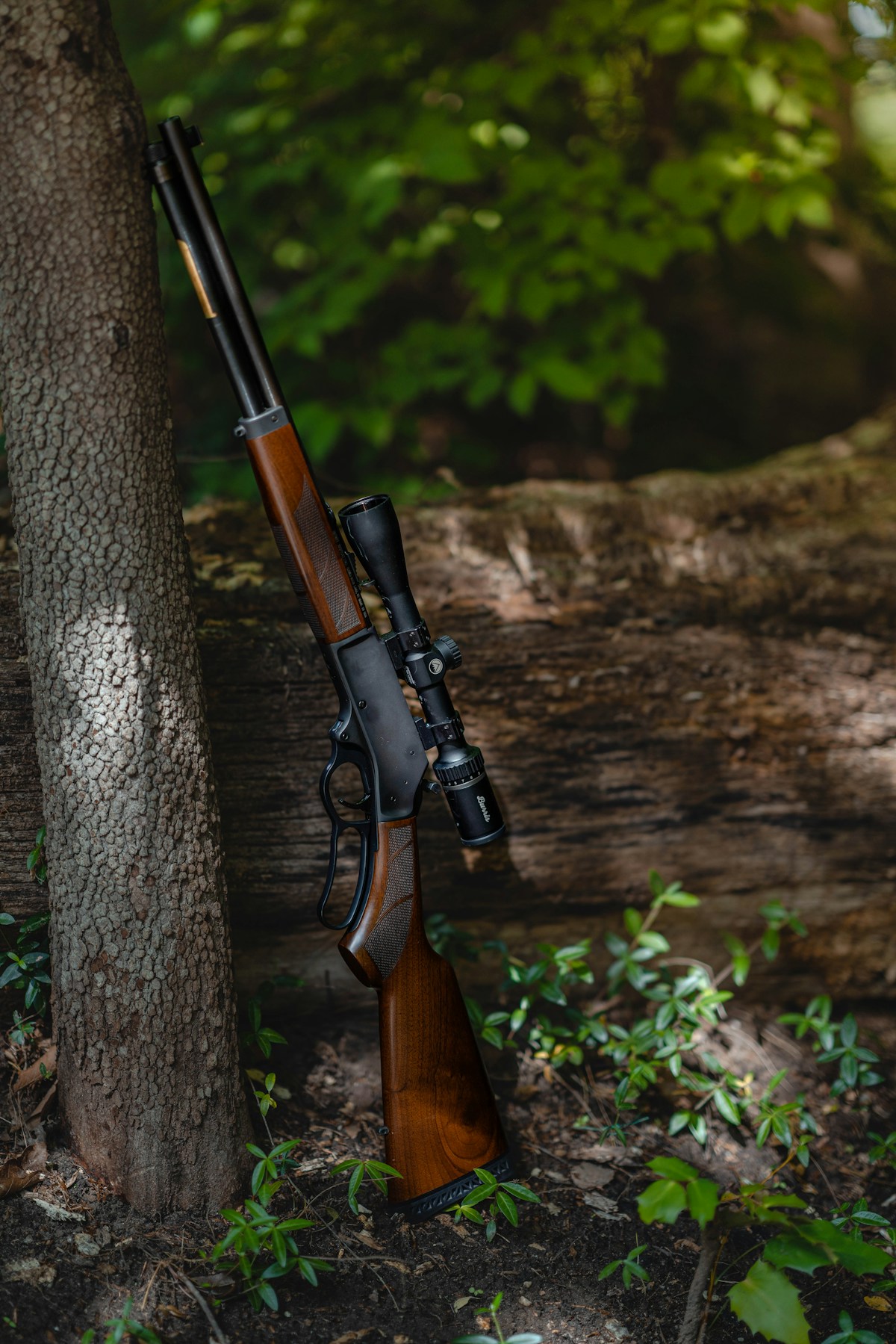
There’s something about a Marlin 336 in .30-30 or a Henry in .45-70 that just feels right in the timber. They’re fast-handling, reliable, and they’ve been killing deer in North America for 150 years.
Practical limits: most lever-action cartridges (.30-30, .45-70, .44 Magnum) are effective to 200 yards or so, not much beyond. You’re also usually limited by tube magazine capacity and the need for round or flat-nosed bullets in traditional tube-fed designs — though Hornady’s FTX bullet solved a lot of that.
If you’re hunting whitetail in thick Eastern timber where 100 yards is a long shot, a lever gun is entirely appropriate. Not for western hunting with open-country shots.
The Browning BLR breaks the traditional limitations — it uses a box magazine instead of a tube, which means spitzer bullets and access to cartridges like .308 and .300 Win Mag. Interesting rifle, though it’s pricier and more complex than traditional lever designs.
Match the Action to Your Hunting Style
Bolt action for most big game. Semi-auto for hogs or situations where fast follow-up shots matter. Lever action for thick timber deer hunting or when you want a rifle that fits a particular style of hunting. There’s no wrong choice here if you make it intentionally.
Barrel Length: The Practical Guide
Barrel length affects velocity, handling, and weight. Here’s the actual math:
Every inch of barrel adds roughly 25-50 feet per second of muzzle velocity, depending on the caliber. The difference between a 20-inch and a 24-inch barrel in .308 is maybe 75-100 fps. In practical hunting terms — 500 yards and under — that’s negligible.
What matters more is handling.
20-inch barrel: Best for timber hunting, tree stands, tight spaces. Light, fast to mount, easier to maneuver. Slightly louder muzzle blast and lower velocity — neither matters inside 250 yards.
22-inch barrel: The all-around ideal. This is where most hunting rifles live by default. You get 95% of the velocity potential, handling is still good, and it works in most environments.
24-inch barrel: The long-range choice. More velocity, flatter trajectory, better at distance. Makes the rifle heavier and less maneuverable. Worth considering if you’re hunting open plains or mountains where shots regularly extend past 400 yards.
26 inches and beyond: Benchrest and varmint shooting, not general hunting. Leave it.
My personal rifles are a 22-inch Tikka T3x for most hunting and a 24-inch Weatherby Vanguard for elk country. The Tikka gets used 90% of the time.
Stock Fit: The Part Nobody Talks About Enough
I’ll be straight with you: a rifle that doesn’t fit your body will cause you to miss. Not might. Will.
Length of pull — the distance from the trigger to the end of the butt stock — is the critical measurement. Standard factory rifles come at about 13.5-13.75 inches. That fits a medium-build adult male reasonably well. It’s too long for a child or small adult and can be too short for a very tall hunter with long arms.
When a rifle is too long, the stock catches on your shoulder, you can’t get a consistent cheek weld, and your eye position shifts relative to the scope. When it’s too short, your head crowds back and the scope can hit you during recoil.
Quick test: With the rifle mounted and pointing at a safe target, close your eyes. When you open them, your dominant eye should be looking through the center of the scope at a comfortable focal distance. If you’re craning forward or pulling back, the stock doesn’t fit.
Most factory synthetic stocks are adjustable now, or can have spacers added. If you’re buying a rifle that fits 80% of the population and you’re in the other 20%, plan for a stock adjustment or a chassis system that offers more adjustment range.
Cheekpiece height matters when running a scope — the comb of the stock needs to be high enough that your eye naturally aligns with the center of the scope when you mount the rifle. Low-comb stocks designed for iron sights often mean your eye ends up below the scope’s optical axis, which hurts accuracy and causes eye fatigue.
Budget Tiers: What You Get at Each Level
Under $500 — The Working Rifles
Don’t let anyone tell you that a sub-$500 rifle is a compromise. Some of the most accurate production rifles I’ve ever shot cost less than $450.
Ruger American — $380–450
Adjustable trigger (3.5 lbs factory, adjustable down to 3 lbs), polymer stock, accepts most standard scope bases. Accuracy is genuinely impressive — I’ve had mine shoot sub-MOA groups with good ammo. Available in every caliber you’d want for big game. Comes with Ruger’s Limited Lifetime Warranty.
Pros: Price, accuracy, trigger, availability in all calibers. Cons: Stock is basic (functional, but not great ergonomics for larger hands), doesn’t upgrade well into a precision platform.
Savage Axis II — $350–420
The AccuTrigger is the story here. It’s a genuinely excellent factory trigger — crisp, adjustable from 2.5 to 6 lbs, and Savage includes a tool for adjustment in the box. For hunters who are picky about their trigger (you should be), the Axis II gets the nod over the Ruger at this price.
Pros: AccuTrigger, price, accuracy comparable to Ruger. Cons: Stock can feel cheap, bolt operation isn’t as smooth as pricier options.
Mossberg Patriot — $380–450
The overlooked option. LBA (Lightning Bolt Action) trigger is clean and adjustable. Available in a lot of calibers including some uncommon ones. Ships with scope rings included. Accuracy is good. Often on sale at Walmart and Bass Pro.
Pros: Price, trigger, includes scope rings, wide caliber selection. Cons: Less brand recognition, aftermarket support isn’t as deep as Ruger/Savage.
$500–$1,000 — Where the Good Stuff Lives
This is the price range where rifles stop being compromises and start being genuinely excellent.
Tikka T3x Lite — $700–800
I’ve said it before and I’ll say it again: the Tikka T3x is the best value in hunting rifles right now. Made in Finland by SAKO, it has an action so smooth it borders on embarrassing for comparable-price American rifles. The trigger is excellent out of the box. Accuracy is consistently sub-MOA.
The T3x Lite specifically has a detachable magazine (huge quality-of-life upgrade over blind magazines) and a synthetic stock that handles weather. It’s light at under 6 lbs, which matters when you’re packing into elk country.
Pros: Action quality, trigger, accuracy, weight, detachable magazine. Cons: Less aftermarket support than Remington 700 platform, stock upgrade options are limited.
Winchester XPR — $500–600
Solid middle-ground option. The MOA trigger system is excellent and the rifle ships with accuracy guarantee documentation. Detachable rotary magazine is a nice touch. Not as refined as the Tikka but noticeably better than the budget rifles in action feel.
Pros: Accuracy guarantee, good trigger, detachable magazine. Cons: Some shooters find the ergonomics awkward; not as smooth as Tikka.
Bergara B-14 Hunter — $850–950
This is the rifle that makes Remington 700 loyalists nervous because it’s objectively better at the same price. Bergara makes match-grade barrels for Savage, Ruger, and others before putting them on their own rifles. The B-14 Hunter has an excellent trigger, a well-shaped stock, and Remington 700-compatible components which means a massive aftermarket. It’s a hunting rifle that can grow into a long-range precision rig with a stock swap.
Pros: Barrel quality, trigger, Remington 700 footprint, excellent accuracy. Cons: Starting to get heavy for a mountain rifle (6.7 lbs), stock upgrades add cost.
$1,000 and Up — When Price Is Just a Variable
At this level, you’re paying for refinement, materials, and often brand heritage. These are all genuinely excellent rifles. None of them will make you a better shot than a well-practiced Ruger American owner.
Browning X-Bolt Pro — $1,400–1,800
Beautiful rifle. Carbon fiber stock, fluted barrel, X-Lock scope mounting system that eliminates most scope shift problems. The action is smooth and the trigger is adjustable. If you want to spend real money on a hunting rifle and have it for 30 years, the X-Bolt Pro is where I’d look.
Pros: Build quality, carbon fiber stock, action feel, X-Lock mounting. Cons: Expensive, the base X-Bolt Hunter at $900 is 90% of the rifle for 60% of the price.
Kimber Montana — $1,500–1,800
Built in Kimber’s Idaho facility, the Montana is what happens when you take a controlled-round-feed action, put a hand-finished barrel on it, and mount it in a Kevlar-reinforced carbon stock. It weighs 4.5 lbs in some configurations, which is remarkable for a full-power hunting rifle. Perfect for a hunter who wants a serious mountain rifle they can carry all day.
Pros: Weight, build quality, Montana-specific performance, CRF action. Cons: Very expensive, not for shooters sensitive to recoil (light rifle + powerful caliber = more felt recoil).
Christensen Arms Mesa — $1,100–1,300
Carbon fiber wrapped barrel and lightweight stock make this one of the best sub-5-pound bolt guns on the market. Christensen’s match-grade steel is consistently sub-MOA and often sub-half-MOA with quality ammo. The Mesa is where serious mountain hunters look when they want to cut weight without cutting accuracy.
Pros: Accuracy, weight, carbon barrel, value compared to Kimber. Cons: Carbon-fiber aesthetics aren’t for everyone; stock bedding can shift in extreme temperature swings.
Don't Skip Practice Because You Bought an Expensive Rifle
I’ve watched hunters spend $2,000 on a rifle and $40 on practice ammo. I’ve watched hunters spend $450 on a rifle and $300 on ammo and range time. The second group shoots better. Every time. No exceptions. The rifle can’t compensate for trigger time.
Optic Pairing: Getting It Right Without Overspending
Let me tell you about a hunt I did in West Texas in 2019. I was after mule deer on a lease outside of Marfa — the kind of country where 300 yards feels like a chip shot and you might find yourself shooting at something in the 450 range. I brought my Tikka T3x with a Vortex Viper PST 4-16x50. Total rifle-and-glass cost was about $1,700.
A guy in our group had a custom-built rifle that probably ran $4,500. He was running a Nightforce ATACR scope worth another $2,200. Fine equipment. Beautiful rifle. He’s a better long-range shooter than me in technical terms.
He got a shot at 380 yards and missed. Clean miss, over the top. Come to find out, he’d moved the scope turrets adjusting for a different hunting trip and hadn’t verified zero. The shot was called right — he just hadn’t confirmed his dope was good before the hunt.
The lesson isn’t that Nightforce scopes are bad. They’re extraordinary. The lesson is that a $6,000 rifle-and-scope combination doesn’t save you if the fundamentals aren’t there. Confirm your zero before every hunt. Verify your adjustments. Know where your rifle is shooting at the distances you’ll encounter.
Scope matching by hunting type:
Whitetail in timber: 3-9x40 is plenty. You won’t shoot past 200 yards in thick cover. The Vortex Crossfire II 3-9x40 ($150) is my budget recommendation — the best scope at that price exists, period. The Vortex Diamondback HD 3-9x40 ($220) is noticeably better glass for a little more money and worth it for low-light hunting.
Elk and mule deer in open country: 4-12x or 4-16x with a 42-50mm objective. The Vortex Viper HD 4-16x44 ($550–650) hits a sweet spot of glass quality, tracking reliability, and price. The Leupold VX-5HD 3-15x44 ($900–1,100) is the premium choice — better twilight performance, lighter, and Leupold’s warranty is legendary.
Varmints and long-range: Variable power with a max of at least 16x and ideally 20x or higher. A first focal plane scope with a range compensating reticle helps here. The Vortex PST Gen II 5-25x50 ($800–1,000) is what a lot of serious long-range hunters run when they don’t want to spend three times that on Nightforce.
The glass rule I live by: Spend 40-50% of your total rifle budget on the scope. If you have $600 for a complete setup, that’s $350 rifle and $200 scope. If you have $1,200, that’s $700 rifle and $450 scope. The glass determines what you can see. The rifle determines where the bullet goes. Both matter.
Common Mistakes to Avoid
Buying for maximum range when you hunt in timber. If your shots are under 150 yards, a flat-shooting long-range cartridge wastes money and recoil on capabilities you won’t use. Match your setup to your actual hunting conditions.
Ignoring fit for looks. A rifle that looks good in the store but doesn’t fit your frame will cause misses. Mount it before you buy it. Close your eyes, mount it, open them — your eye should be looking through the center of the scope.
Skipping the budget on scope rings and bases. The rings and bases connect your $600 scope to your $500 rifle and they should not cost $12. Cheap rings will shift zero. Leupold, Warne, or Vortex rings in the $30-60 range are where I’d set the floor.
Buying ammo based on price per box. The cheapest bulk ammo is for the range. Use premium ammunition in the field — Federal Terminal Ascent, Nosler Partition, Swift Scirocco II, Hornady ELD-X. These bullets are engineered to expand consistently across a wide velocity range, which matters when your shot distance varies from 50 to 400 yards in the same hunt.
Thinking one rifle does everything. It’s an appealing idea. The truth is a .308 in a 22-inch barrel is genuinely versatile — it handles deer, elk, black bear, hogs, and reaches out to 500 yards — but varmint hunters want a different setup, and dedicated long-range competition shooters want a different setup. Start with a versatile all-around rifle and specialize later if you find yourself needing to.
Your First Two Rifles
If you could only own two hunting rifles, make them: (1) a bolt-action in .308 or 6.5 Creedmoor with a 3-9x40 scope for big game, and (2) an AR-15 or bolt .22 LR for practice, varmints, and small game. These two cover 95% of hunting scenarios in North America and the practice time on the .22 will make you dramatically better with the centerfire.
The Honest Answer on What to Buy
After all of this, let me make it concrete. If you walked up to me at deer camp tonight and said, “Jake, what rifle should I buy?” — here’s what I’d actually say depending on your situation.
Hunting whitetail on a budget: Ruger American in .308 or 6.5 Creedmoor, Vortex Crossfire II scope. Total out-the-door around $600. You’ll kill deer. Reliable setup.
Hunting whitetail and want a rifle you’ll keep for 20 years: Tikka T3x Lite in 6.5 Creedmoor, Vortex Diamondback HD 3-9x40. Total around $950-1,000. This is the rifle I wish I’d bought first instead of the Ruger I traded through.
Elk hunting in the West: Bergara B-14 Hunter in 6.5 PRC or .300 Win Mag, Vortex Viper HD 4-16x44. You want a cartridge with authority at distance and a scope that handles the magnification.
Hog hunting: Don’t overthink it. An AR-15 in 5.56, an AR-10 in .308, or even a simple Ruger American in .308 with a fixed 4x scope. Hogs aren’t delicate. They need to die.
The one rifle to rule them all: If I could take only one rifle hunting for the rest of my life, it would be a Tikka T3x in .308 Winchester with a Vortex Viper HD 4-12x44 scope. Not the most exciting answer. But it handles deer, handles elk with the right bullets, shoots flat to 400 yards, and I’ve never had it fail me in any weather condition I’ve hunted in.
The rifle matters. But the shooter matters more. Buy something reliable within your budget, put real rounds through it at the range, and learn how it behaves at the distances you’ll actually shoot.
That’s the guide. Don’t overcomplicate it.
Looking for related content? Our beginner deer hunting guide covers everything from pre-season scouting to shot placement. If you’re dialing in optics next, check out the hunting caliber comparison for a deeper look at the cartridges mentioned here.