This article contains affiliate links. We may earn a small commission if you purchase through these links, at no extra cost to you.
Southern Ohio. My uncle’s property.
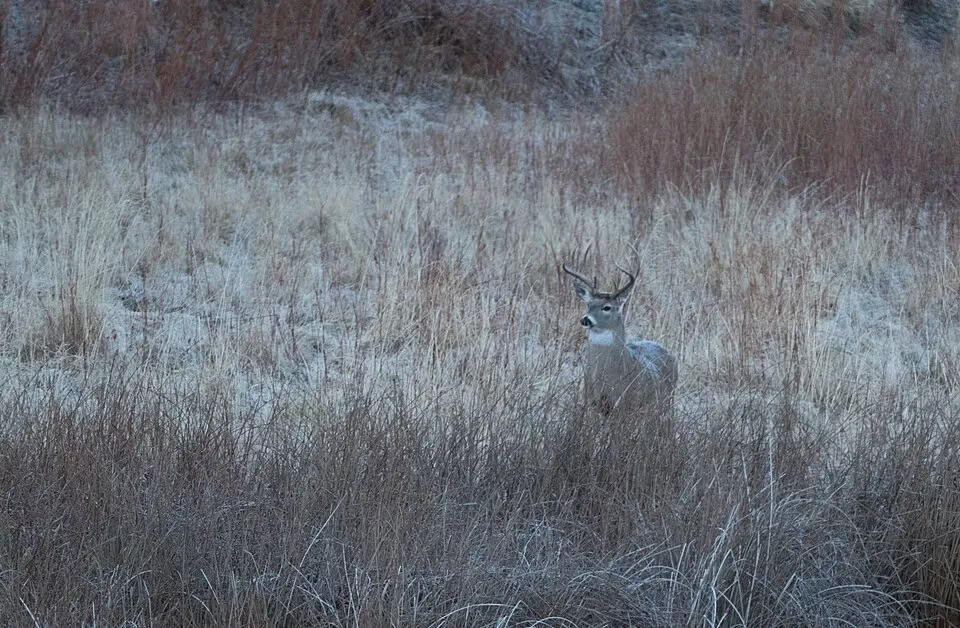
I killed my first deer that morning — a four-point whitetail buck — and I almost didn’t. I’d been up in this wooden stand since maybe 4:30, wearing cotton jeans like an idiot because nobody bothered to tell me that cotton will literally try to kill you when it’s cold and wet. By nine o’clock I was done. Mentally checked out. Thinking about the Waffle House on Route 35.
Then this buck walks out of a thicket about 80 yards out. Just… walks out. Like nothing in the world could touch him.
My hands wouldn’t stop shaking. Cold, adrenaline, probably the gas station breakfast burrito too. Had to jam the rifle against the stand rail to get anything close to a steady sight picture.
Made the shot. Barely.
Anyway. That one morning taught me more than two years of reading magazines and watching hunting shows combined. But I also screwed up about fifteen things before I even pulled the trigger that day. Wrong clothes, bad stand location, zero scent control. I mean I literally ate a bean burrito at 4 AM and wondered why I wasn’t seeing deer.
So yeah. You can skip all of that. I already made every mistake — might as well save you the trouble.
Licenses First. I Know, I Know.
Nobody wants to start here. You want to talk rifles and camo and tree stands and all the cool stuff. Me too. But listen — getting caught in the field without a valid tag is expensive. Like, really expensive. My cousin got popped in West Virginia a few years back. I was standing maybe twenty feet away when the game warden walked up. The look on his face. Man.
So. Hunter safety course first. Every state requires one. Most of them are online now, you do a half-day in-person field session, pay like twenty-five bucks and you’re certified for life. Do it on a random Saturday when you’ve got nothing else going on.
Here’s the part that confuses people though. You don’t just buy “a hunting license” and go. No. You need a general hunting license, which is one purchase. And then you ALSO need a deer-specific tag, which is a separate purchase. Two different things. I’ve seen guys show up opening morning with only one and have to pack it in.
And if you’re thinking about hunting out west? Colorado, Montana, that kind of thing? Some of those units are lottery draw only. Especially for mule deer. You might apply three years before you draw a tag. Just how it works out there.
Season dates are a whole other headache. When you can shoot, what you can shoot with, how many you can take — it’s all different everywhere. Pennsylvania has separate reporting rules for archery and rifle seasons and my buddy Dave found that out the hard way. Twelve hundred dollar fine. FOR PAPERWORK. He literally brings it up every Thanksgiving. His wife rolls her eyes so hard I think she’s going to hurt herself.
Two Tags, Not One
A general hunting license and a deer-specific tag are separate purchases in every state. Showing up with only one will end your hunt before it starts. Check your state wildlife agency’s website to confirm exactly what you need before opening day.
Watch: Off-Season Scouting and Field Skills
You Don’t Need to Spend Three Grand on Gear
Walk into Bass Pro. Go ahead. They’ll have you convinced you need to take out a second mortgage before you can sit in a tree. Forget that.
My best season ever — I took three deer, two does and a buck — I was using a Savage 110 I found at a pawn shop for $280. Wore Walmart thermals. A Carhartt jacket with paint on it from when I helped my neighbor stain his fence the summer before. Total outlay for the whole season, ammo included: maybe five hundred bucks. Maybe.
My first piece of advice on gear: don’t start with a bow. Just don’t. Archery hunting is incredible but it’s a completely different skillset and the learning curve is steep enough to discourage you. Year two or three for that.
Get a bolt-action rifle. I’d go .308 Winchester. The .30-06 crowd will yell at me for saying that but whatever. The .308 recoils less. Ammo costs less. And honestly? I’ve watched enough new hunters flinch behind a .30-06 to know that shot placement matters more than ballistics. A .308 you shoot well beats a .30-06 you’re scared of.
Used gun rack at your local shop. Or GunBroker if you know what you’re looking at. Ruger American, Savage Axis — either one in decent shape goes for about $300. These rifles are absurdly accurate for the money. My buddy Chris prints half-inch groups with a Savage that cost him $275. I’ve been shooting twice as long as him and I can’t do that with my rifle that cost three times as much. It’s embarrassing honestly.
Slap a Vortex Crossfire II on top — $150, maybe $200 depending where you find it — and that’s your setup. Done. Hand it down to your kids someday.
Clothes are actually pretty simple. Three layers.
Base layer: synthetic or merino wool. NOT COTTON. I cannot stress this enough. Cotton absorbs moisture, holds it against your skin, and then when the temperature drops you’re basically wearing a wet towel in thirty degree weather. I learned this by almost getting hypothermia my first season. Fun times.
Middle layer: fleece or wool. Doesn’t need to be fancy.
Outer layer: something that blocks wind.
That’s it. Don’t let some sales guy talk you into a $300 jacket. A $40 Costco fleece does the exact same thing. I’m serious.
Boots: go rubber. Yeah, leather looks better. But rubber doesn’t hold your scent, handles mud better, and dries way faster. Trust me on this one.
And camo — okay this might be controversial but I genuinely don’t think camo matters as much as the hunting industry wants you to believe. My uncle once sat perfectly still in a full blaze orange vest and had a doe walk close enough that he could have reached out and slapped her on the butt. Didn’t move a muscle. She had no idea he was there.
Stillness beats camo. Always has. Always will.
Stuff you’ll forget to pack: A knife (a $30 Morakniv, not some $200 custom thing you’re afraid to get dirty), game bags, headlamp, drag rope, and for the love of god bring snacks. You will be cold. You will be hungry. At 2 PM when you haven’t eaten since that granola bar at dawn, you will hate yourself for not throwing a couple Clif bars in your pack.
Cotton Kills in Cold Weather
Never wear cotton as a base layer when hunting in cold or wet conditions. Cotton absorbs sweat and holds moisture against your skin, dropping your body temperature fast. Hypothermia can develop at temperatures well above freezing when you’re wet and sitting still for hours.
Deer Are Creatures of Habit (Use That Against Them)
Okay so here’s how I think about deer behavior and this might sound weird but bear with me.
Think about your drive to work. You take the same route right? Same highway exit, same Starbucks, same parking spot. Every day. Unless construction or an accident forces you to change, you’re on autopilot.
Deer do the exact same thing. They sleep in thick cover, they travel the same trails to food and water, and they repeat that loop until something spooks them off it. That’s it. That’s the whole secret.
Your job is to figure out their “commute” and then sit in the “parking lot” before they show up. That’s deer hunting in one sentence.
Scout a month before the season if you can. Look for tracks, droppings, rubs on trees (that’s where bucks scrape the velvet off their antlers), and scrapes on the ground (think of scrapes like… deer Instagram during the rut. They’re checking who else has been there).
Throw a trail camera on a field edge or creek crossing. Forty bucks at Walmart. I’m telling you, two weeks of trail cam footage will teach you more than a month of walking around in the woods scaring everything off.
Oh — and this is important. This trips up SO many people. Pay attention to what food is available DURING your season dates. Not before. During. Deer shift food sources as fall goes on. Soybeans in September, acorns in October, woody browse by November. The guy who scouted a bean field six weeks before the season? He’s going to be sitting over nothing by opening day because those beans got harvested in October.
Ask me how I know. Third year hunting. Sat over an empty cornfield for three straight days. THREE DAYS. Finally hiked over to the oak ridge a half mile east on day four. Tracks everywhere. Fresh scrapes. They’d been there the whole time.
I wanted to scream.
Scout the Food That's There During Season, Not Before
Deer shift food sources as fall progresses — soybeans in early fall, acorns through October, woody browse by November. Scout the food sources that will actually be present during your specific season dates, not whatever was there when you walked the property in August.
Shot Placement (Read This Part Twice)
I’m not going to dress this up or be polite about it.
This section matters more than everything else in this article combined. Ethically, practically, all of it.
A deer hit in the heart and lungs — right behind the front shoulder — goes down fast. Usually inside a hundred yards. Sometimes they drop right there. That’s what you want. Quick. Clean.
A deer hit in the gut suffers for hours. A deer hit in the leg might run for miles and you’ll never find it. It’ll die somewhere three days later. Coyotes will find it before you do.
I’m not trying to be dramatic. That’s just reality. And I think about it every single time I look through a scope.
So. Go to the range. Shoot until you can put five rounds inside a six-inch circle at whatever distance you expect to shoot. Most tree stand hunting is under 150 yards. If you can’t hold that group? You’re not ready yet and that’s totally fine. There’s no shame in it. There is shame in wounding an animal because you got impatient.
Broadside shots. That’s what you’re looking for. Deer standing sideways to you. Crosshairs behind the shoulder, about a third up from the belly. Quartering away works too — aim through to the far shoulder. Quartering toward you? Nope. Too much bone in the way.
Headshots? No. I don’t care what you saw on some YouTube compilation. The kill zone on a deer’s head is about the size of a baseball. At 100 yards. With adrenaline. In low light. If you miss by two inches, you blow the jaw off and that animal starves to death over weeks.
Just… no.
Pass on the Shot If You're Not Confident
If you can’t hold a consistent group at your expected shooting distance, you are not ready to shoot at a deer. Wounding an animal that runs off and dies slowly is the worst outcome in hunting — ethically, practically, and personally. There is no shame in waiting for a better opportunity.
After You Shoot (The Part Nobody Warns You About)
Bang. The deer takes off running.
Now what.
Sit down. Breathe. Do not climb out of that stand for thirty minutes minimum. I know you want to. Every cell in your body is telling you to go find that deer RIGHT NOW. Don’t.
Here’s why. A well-hit deer beds down within a hundred, maybe two hundred yards and dies. But if you push it — if you get down there and start chasing before it’s expired — that deer gets back up and runs another half mile. Into the neighbor’s property. Into a swamp. Into a ravine you can’t get a four-wheeler into. And now you might never find it.
Thirty minutes. Sit there. I don’t care if it feels like three hours. Sit there.
Okay. Now go to where the deer was standing when you took the shot. Look down.
Blood tells you everything:
Bright red, bubbly, kind of frothy looking? Lung hit. Your deer is probably piled up within 80 yards. Go get it.
Dark red, thick? Liver. The deer is dead but give it another hour to be safe.
Greenish stuff, smells awful? Gut shot. This is bad. Wait four hours. Maybe overnight if it’s cold enough (under 50 degrees). I know that sucks. I know. But going after a gut-shot deer too early just pushes it further away.
For field dressing, I’ve got a full step-by-step guide that covers the real version nobody shows on YouTube. The short version: deer on its back, open from pelvis to ribcage, take out the organs, get the body cooling as fast as possible.
Bring nitrile gloves. You’ll thank me.
The Stuff Nobody Writes Down
Hunting has rules that aren’t really rules. They’re just… the way it’s done. And if you violate them people will remember.
Ask permission before you hunt someone’s land. In writing if you can. Find someone else’s tree stand on public land? Hunt somewhere else. Your deer runs onto the neighbor’s property? You knock on their door and ask before you set foot over there. You share meat with people. You bring the landowner who let you hunt a cooler full of venison or at minimum a thank-you six-pack. (Bourbon works too. Just saying.)
And look. This is going to sound cheesy but I’ve been doing this for over twenty years and I’m just going to say it anyway.
The best days I’ve ever had hunting? Most of them, I never fired a shot.
Watching the sun come up over a frozen creek in dead silence. A red-tailed hawk diving on a field mouse thirty feet from my stand. The first snow of the season falling through bare timber while I’m sitting there with a thermos of bad coffee and nowhere else I’d rather be.
I don’t know. Maybe that sounds stupid written down. But the kill isn’t the point. It really isn’t. And the guys who’ve been at it long enough will tell you the same thing.
Anyway. Good luck out there. If you’re still picking your first rifle, read our guide on the best hunting rifles for beginners before you make the same mistake I did. And you’ll want a solid knife — our survival knives under $100 guide covers the ones I actually use.
If you want to see how much of this actually stuck, try our hunting safety quiz. No judgment if you bomb it — just means you’ve got some more reading to do.